

Your AI dashboard has never looked better. Gallup’s workplace panel, a probability-based survey of U.S. employees, shows AI use at work nearly doubled in two years: 21% to 40%, a 19-point jump. The panel measured that doubling from 2023 to 2025. That is the number your board sees, so on paper your rollout worked.1
But that doubling has not shown up in measured output. Economists tracked about 25,000 workers in a Danish national study through 2024 and found a precise null. They rule out any effect on earnings and hours larger than 2%.2
And this morning two of your best operators gave notice. You priced every seat of the license to the dollar, so you can say exactly what your AI costs. The thing that failed first never made the P&L.
📬 Every week I translate research into actionable plays you can run in your organization to discover the ROI hidden in your AI spend. Receive the AI Playbook in your inbox and use it as part of your strategic plan for the week.
The Fear Is a Forecast
That missing line item has a name your people already use. Only 22% of employees say their organization has communicated a clear AI plan, in that same 2025 Gallup survey.1 Gartner surveyed 110 CHROs in late 2025. Among them, 95% run organizations that have implemented AI, and only 20% report significant value. So 80% of your peers are paying for a capability their own leadership cannot yet see in the numbers.3
That value gap has a practitioner’s number attached. Melissa Reeve, the practitioner behind the Hyperadaptive framework, puts a scale on it in her January 2026 article: “Nearly 80%” of AI initiatives fail — her framework’s number, an estimate by her own sourcing. That leaves you paying for a stack most of your people cannot explain the purpose of.4
The fear of AI isn’t a feeling to be managed. It’s a forecast — and your people are reading your hiring plan, not your reassurances.
Your people distrusted leadership before AI arrived. In Gallup’s 2022 panel, 21% of U.S. employees strongly agreed they trust their organization’s leadership, down from 24% in 2019. Read it the other way: 79% do not.5
But reassurance will not fix this. Conor Grennan tells leaders to validate the fear as rational; I go further — your people are forecasting. Economists Frey and Jegen showed in 2001 that workers withdraw willing effort when a policy feels controlling.6 That withdrawal shows up across 128 experiments analyzed in 1999: compliance rewards pushed motivation down and honest feedback pulled it up.7 Your mandate and your praise cancel each other out.
Your Hiring Plan Told Your Seniors They’re Next
Reassurance is not the plan your people are reading. They read it in what you do. Shopify’s chief executive Tobi Lütke told teams in an April 2025 self-published memo to justify why AI cannot do a job before asking for headcount and resources.8 And 22% of those 110 CHROs report at least one business leader who stopped entry-level hiring because of AI. The telling unit there is one leader each, not 20% of companies. Even so, that is a policy your junior candidates can see from outside the building, so your senior operators are certainly reading it from inside.3
That reading gets easier when a CEO says it out loud. Salesforce’s Marc Benioff told the same outlet twice in 2025. On July 30 he told Fortune: “I think AI augments people, but I don’t know if it necessarily replaces them.” Five weeks later, on September 2, he described cutting the support organization from 9,000 people to about 5,000. That is a 44% decrease, “because I need less heads.” The cut also drove support costs down 17%. Your own people read sequences like that one, and what they take from it is the plan, not the reassurance.9
Those two dates sit five weeks apart in the public record, and your senior operators can read a calendar. The junior evidence sits in three numbers with three distinct and separate scopes:
Occupations (ages 22–25). Stanford’s “Canaries” series — covered in July’s The Apprenticeship the Machine Ate — shows workers in the most AI-exposed occupations about 19% below less-exposed peers, in payroll data through June 2026. Descriptive, the authors say, not causal.10
Industries (ages 22–24). A U.S. Census Bureau working paper finds early-career employment in the most AI-exposed industries fell 12% in the ten quarters after ChatGPT launched, through mid-2025; up to 25% of that may be monetary policy.11
Major tech companies only. SignalFire — published in July 2026 — puts new-grad hiring at the major tech companies roughly 65% below 2019, and specifically isolates that drop from the wider economy.12
Those three scopes describe different populations, and none of them needs a press release to reach your staff. Reuters’ factbox shows companies attributing layoffs to AI on the record; but even when the attribution isn’t overt — especially as entry-level jobs start disappearing — it doesn’t take a press release for your employees to read the tea leaves.13 Your employees price your AI promise by what you do, not by what you say.
The Bill Prices Who Leaves — and Who Stays
Behavior that reads as a broken promise has a price, and it arrives in two currencies. Gallup priced the first in 2019, by their own and undisclosed formula. Replacing an employee costs 50% to 200% of their annual salary: half a year’s pay at the floor, twice a full salary at the ceiling. In Gallup’s own arithmetic, that costs a 100-person organization up to $2.6 million a year.14
Salary multiples understate it, because layoffs also multiply the outflow. Downsizing just 0.5% of the workforce raised voluntary turnover 25% the next year. The 2008 study’s baseline quit rate ran 10.4%, so a very small cut produced a very large extra exit.15 Those extra exits compound at the top. After one high performer quits, other high performers’ quit rate rises 6% per month for the next three months. The 2024 study covered 1,620 retail stores, so treat it as a mechanism you can watch for in your own exit data rather than a rate you can apply to your business directly.16
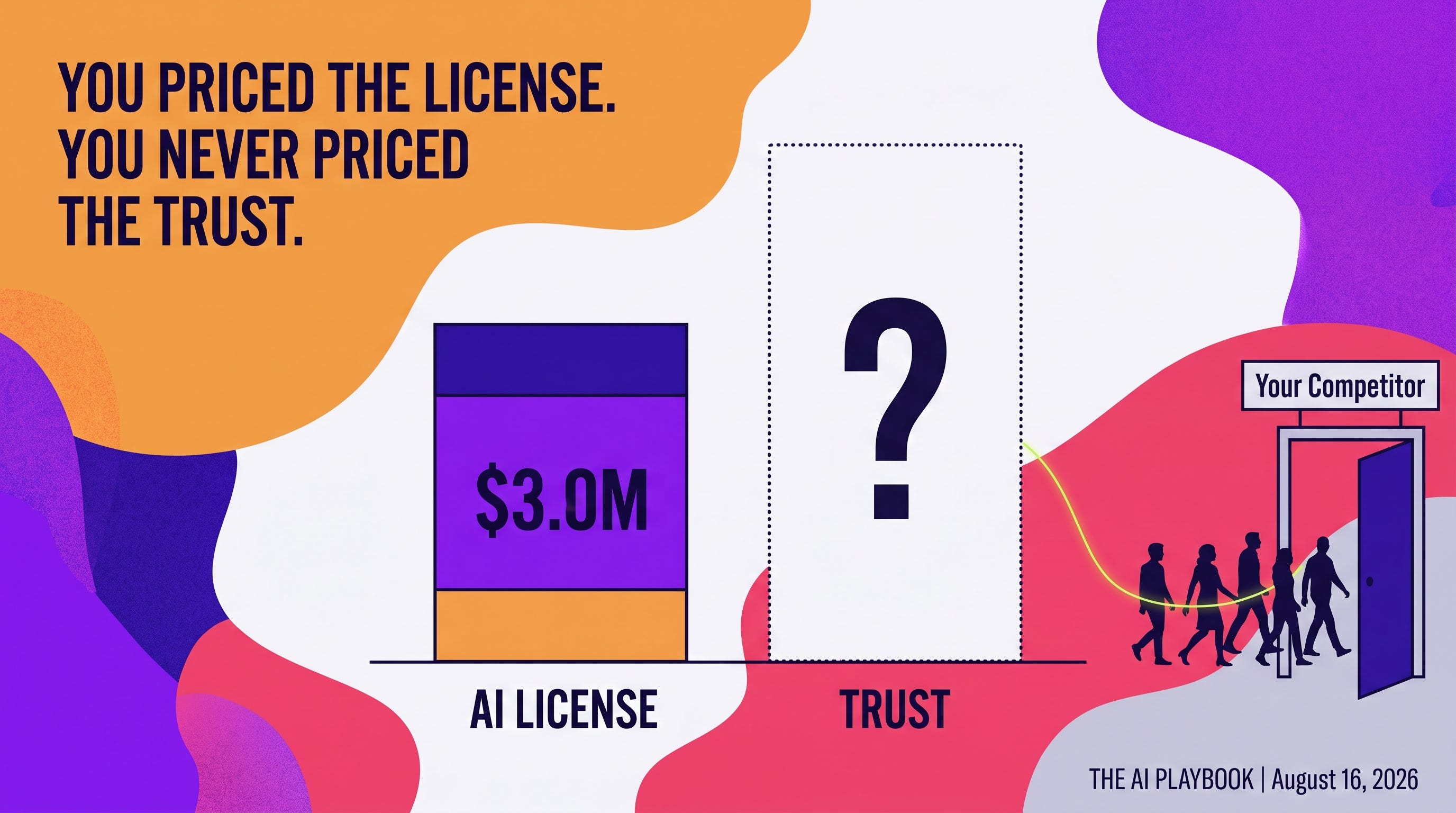
If you never price the trust, how does the license you did price ever pay back?
Now the cost exit metrics never show. In 2007, researchers analyzed 51 studies of psychological-contract breach: the implicit deal employees build from perceived promises. Breach drives mistrust of management and drags satisfaction, commitment and daily performance — it does not predict actual turnover. That null is the point: the damage hides in the people who stay, so your retention dashboard stays green while the work quietly gets worse. Relational promises — job security, support — hurt more when broken than pay promises, and the AI job-safety promise is relational.17
Your People Beat AI Performance Only When You Let Them Learn
Here is where the hiring plan and the performance data collide. You are cutting the least experienced people, and the least experienced people are exactly who AI helps most.
That collision is visible in the field evidence. Human support agents working with an AI assistant resolved 15% more issues per hour. Among the least-skilled of them, the gain reached 30%. The 2025 study followed 5,172 human representatives.18 The dividend concentrates on novices, which is to say: in the roles your hiring plan just stopped filling. That means the cheapest productivity you can buy is sitting in the job you are no longer hiring for.
Then in May 2026, a Max Planck Institute-led team re-analyzed the same dataset that had powered a 2024 Nature Human Behaviour meta-analysis of human-AI experiments. The re-analysis covered 370 effect sizes from 106 experiments.19 Nearly all of those experiments ran on laboratory tasks with pre-GPT-4 systems between January 2020 and June 2023. In 86% of those studies, people never received outcome feedback — nobody ever told them whether the machine had been right.20
Feedback, where it existed, tilted results toward synergy; feedback plus AI explanations turned positive, while explanations without feedback stayed clearly negative. Their conclusion, from a preprint the authors call tentative: “explanations increase synergy only when humans can learn to verify the AI’s reliability through feedback”.20 That means you may be hitting a condition you set, not a limit of the technology you bought.
The collaboration success ceiling isn’t fixed. It improves when you provide the human feedback, learning, and the safety to verify the machine.
Feedback and the chance to learn are conditions, and conditions are what an employer supplies. Two organizations bought identical licenses; the one whose people could learn to check the machine got the return, and the one whose people could not, got confident errors at speed. The demonstration came from 758 BCG consultants in a 2023 study BCG co-authored. They finished 12.2% more tasks inside the AI’s competence, with more than 40% higher quality. Beyond the AI’s competence, consultants were 19 points less likely to be correct. The penalty travels with the gains, so the same tool that lifts your team also sets a trap for it.21
That same split ran on live customers at two companies. Klarna automated customer service to lower cost and got worse service. Its chief executive told Bloomberg in May 2025: “Really investing in the quality of the human support is the way of the future for us.” Klarna began recruiting human agents again, while saying it is “very much still AI-first” — a partial rollback, not a reversal. That correction still cost it twice: the quality it lost, and the credibility it spent.22 Commonwealth Bank of Australia went further. In August 2025 it rescinded 45 voicebot-attributed redundancies, apologized to the staff it had let go, and conceded through its own statement that the cuts were an error.23
Both cases read differently. Both companies removed the humans, watched quality fall, and hired back; that means the people they cut were producing value their dashboards had priced at zero. Your workforce is watching for that same sequence. It could cost you twice: once when the service degrades, and again when the promise you broke wasn’t predicated on verified AI results.
The Breach Is a One-Way Door
That broken promise stays broken. Hiring back, as both companies did, does not buy the trust back. Researchers settled what trust is worth two decades ago: a 2002 meta-analysis covered 27,103 employees.24 Across 106 samples, employees who trust their leaders report higher job satisfaction and stay more committed. Trust ranks among the strongest predictors researchers have measured. Those same employees plan to leave far less often. That means you already pay for satisfaction, commitment, and retention through a variable your budget never priced.
These two findings agree. Gallup counted how many employees trust leadership in 2022, and found few. Dirks and Ferrin measured what changes where that trust exists, across studies published through 2001. Trust is both rare and load-bearing.24,5
That trust has a sharper finding underneath it: it matters who the employee is trusting. Employees work measurably better for a manager they personally trust. Those same employees gain nothing measurable from trusting ‘the leadership’ in the abstract. So you intervene with the manager, not with the message. Give every manager in your organization the training and the authority to build trust with their own reports, and you convert that research finding into output — never by proxy through you, and never through a policy.24
That manager can also recover from a mistake in a way the company ‘we’ cannot recover from a broken promise. Trust-repair studies run in the laboratory explain why that door swings one way. In 2004, researchers showed an apology helps rebuild trust after a competence failure. After an integrity violation it barely helps. A missed forecast reads as a mistake. A broken promise reads as a failure of character.25
Apology repairs a competence failure. A broken promise reads as failure of character — and no study documents a reliable road back.
That character judgment changes behavior. Employees who distrust leadership hide how they use AI. In 2025, KPMG, the global professional-services firm — AI governance among its services — funded a study, and University of Melbourne researchers ran it. They surveyed over 48,000 people across 47 countries. In that survey 61% of employees avoid revealing when they use AI, and 44% use it against policy. The AI activity inside your company is already larger than the activity you can see. This KPMG survey also anchored August’s Your AI ROI Is Hiding in the Judgment Layer.26 Hidden use is unmanageable use, and it is sitting in your organization right now.
Now the other side of the door: in 2017, researchers combined 136 samples on psychological safety.27 Teams that feel safe report their own errors, and reporting is how they learn — the link to learning is strong, the link to output more moderate. These are patterns rather than proven causation.
That link has a mechanism. Amy Edmondson’s original 51-team study at one U.S. manufacturer traced it in 1999: reporting errors is how teams learn, and learning is what lifts performance. So your people surface AI failures when they trust you, and those reports buy you an early warning no dashboard sells.28
Your people already show you what they think of the promise — in what they hide, and in what they report.
State the Plan — Then Hand Over the How
That willingness is buildable, and the first condition costs one page. State the plan, plainly:
Human + AI: where, and how.
AI-only: where, how to verify accuracy, and who owns verification.
Human-only: where, and why.
Then never promise what your hiring plan will contradict. Ambiguity is where the tacit breach lives — only 22% of employees say they have heard a clear AI plan at all, in that same 2025 survey.1
A clear plan is also what makes a repair possible, and Duolingo shows one that worked. Its April 2025 memo said the company would “gradually stop using contractors to do work that AI can handle”. After weeks of backlash, chief executive Luis von Ahn walked it back — he reverted; he never apologized: “To be clear: I do not see AI as replacing what our employees do (we are, in fact, continuing to hire at the same speed as before)”.29
His behavior made that clarification stick: no full-time layoffs in 17 years, and hiring continued. The cuts did fall on contractors, so hold that distinction when you tell this story internally. By May 2026 he dropped his AI-usage performance rule because workers used AI “just for AI’s sake,” so the mandate half died of its own theater. What held was the half backed by behavior, which is the half your people will judge you on too.29
The second condition is autonomy over the how, and it is trainable. Hardré and Johnmarshall Reeve ran a randomized experiment, published in 2009: five weeks of coaching moved managers’ behavior by more than a full standard deviation — a large shift, the kind that changes what a team notices day to day — and employee engagement moved with it, by a smaller but real margin. The researchers never tested durability beyond those five weeks.30 That training is something you can commission this quarter, and you can measure what it moved.
That training changes how managers behave. The third condition: psychological safety, so your teams surface where AI fails instead of hiding it.
Those three conditions — a stated plan, autonomy over the how, and the safety to surface failures — cost less than the license. When you sit down to price next quarter’s AI budget, the cheapest line item on it will be the one that was never there. Trust buys participation; judgment aims it. That aim is what the consultants’ 19-point penalty measures: willing misuse without judgment, which is how your best people come to ship confident errors at speed. Judgment stays the lead lever — trust is what gets your people to pull it.21,19
This is the work I do with executives: I map the revenue hiding in your AI spend, sharpen the judgment that’s forfeiting it, and instrument the capture. The AI ROI Map tells you where your AI spend is paying, where it’s forfeiting return, and the moves that capture it — the trust conditions above decide how much there is to capture.
The org talent flights to is the org that captures the AI return. Trust is the dividend.
Trust is also the dividend your people are already pricing. They know which organization you are becoming. This week, tell them — in writing. Measuring the willing use your dashboard cannot see gets its own forthcoming Call.
The AI Leadership Playbook
These questions put that plan on someone’s desk this week.
Strategic Questions (copy-paste ready for an email to your CFO and CHRO):
Which of our AI communications promised our people safety — and does our hiring plan contradict it? What changes first: the promise or the plan?
How much of our adoption number is willing use versus mandated performance — and which behavior-revealed measure do we add first?
If our two best operators left for the organization that kept its promise, what would replacing their judgment cost us?
Your Next Plays (copy-paste ready for an email to a direct report):
Draft the stated plan. One page: human+AI, AI-only, human-only — where and how, each. Check it against the hiring plan before anything ships.
Pressure-test the adoption dashboard. Separate autonomous AI-agent invocations from human use; add one measure no one can game by running up usage — voluntary error-surfacing is the candidate.
Put the trust lever where the research says it lives: the direct manager. Commission autonomy-supportive manager training — five weeks moved manager behavior by more than a standard deviation — and measure engagement before and after.30
📅 Book a complimentary 1:1 Strategy Session—45 minutes to start the conversation about mapping the revenue hidden in your AI spend.
And one disclosure before the Sources: I worked at Salesforce during the period described in this Call, with no involvement in the decisions reported here.
Sources
Gallup, AI Use at Work Has Nearly Doubled in Two Years. https://www.gallup.com/workplace/691643/work-nearly-doubled-two-years.aspx
Humlum & Vestergaard, Still Waters, Rapid Currents (NBER working paper w33777). https://www.nber.org/papers/w33777
Gartner, CHRO survey press release, July 2026. https://www.gartner.com/en/newsroom/press-releases/2026-7-27-gartner-survey-finds-ai-automation-is-reducing-some-entry-level-hiring-at-nearly-one-quarter-of-organizations
Melissa Reeve, The 5 Stages of Becoming AI-Native, IT Revolution. https://itrevolution.com/articles/the-5-stages-of-becoming-ai-native-the-hyperadaptive-model/
Gallup, Why Trust in Leaders Is Faltering and How to Gain It Back. https://www.gallup.com/workplace/473738/why-trust-leaders-faltering-gain-back.aspx
Frey & Jegen, Motivation Crowding Theory, Journal of Economic Surveys. https://onlinelibrary.wiley.com/doi/10.1111/1467-6419.00150
Deci, Koestner & Ryan, meta-analytic review of extrinsic rewards and intrinsic motivation, Psychological Bulletin. https://home.ubalt.edu/tmitch/642/articles%20syllabus/Deci%20Koestner%20Ryan%20meta%20IM%20psy%20bull%2099.pdf
Shopify memo coverage, Digital Commerce 360, April 2025. https://www.digitalcommerce360.com/2025/04/08/internal-memo-shopify-ceo-declares-ai-non-optional/
Fortune, Benioff on support-role cuts, September 2, 2025 (and prior interview, July 30, 2025). https://fortune.com/2025/09/02/salesforce-ceo-billionaire-marc-benioff-ai-agents-jobs-layoffs-customer-service-sales/
Stanford Digital Economy Lab, Canaries in the Coal Mine? (August 2026 revision). https://digitaleconomy.stanford.edu/news/canariesaug26/
U.S. Census Bureau (Tucker), You’re (not) Hired, CES-WP-26-27. https://www.census.gov/library/working-papers/2026/adrm/CES-WP-26-27.html
SignalFire, State of Talent Report 2026. https://www.signalfire.com/blog/signalfire-state-of-talent-report-2026
Reuters factbox on AI-attributed job cuts, July 6, 2026 update. https://www.investing.com/news/stock-market-news/factboxcompanies-cutting-jobs-as-investments-shift-toward-ai-4776976
Gallup, This Fixable Problem Costs U.S. Businesses $1 Trillion. https://www.gallup.com/workplace/247391/fixable-problem-costs-businesses-trillion.aspx
Trevor & Nyberg, downsizing and voluntary turnover, Academy of Management Journal. https://journals.aom.org/doi/10.5465/amj.2008.31767250
Sajjadiani et al., high-performer turnover dynamics, via LSE Business Review. https://blogs.lse.ac.uk/businessreview/2024/03/13/when-a-high-performer-leaves-the-firm-loses-more-than-a-good-worker/
Zhao, Wayne, Glibkowski & Bravo, psychological contract breach meta-analysis, Personnel Psychology. https://onlinelibrary.wiley.com/doi/abs/10.1111/j.1744-6570.2007.00087.x
Brynjolfsson, Li & Raymond, Generative AI at Work, Quarterly Journal of Economics. https://academic.oup.com/qje/article/140/2/889/7990658
Vaccaro, Almaatouq & Malone, When combinations of humans and AI are useful, Nature Human Behaviour. https://www.nature.com/articles/s41562-024-02024-1
Berger et al. (Max Planck Institute for Human Development), Fostering human learning is crucial for boosting human-AI synergy, arXiv preprint. https://arxiv.org/abs/2512.13253
Dell’Acqua et al., Navigating the Jagged Technological Frontier. https://papers.ssrn.com/sol3/papers.cfm?abstract_id=4573321
Fortune, Klarna coverage, May 9, 2025. https://fortune.com/2025/05/09/klarna-ai-humans-return-on-investment/
The Register, Commonwealth Bank coverage, August 22, 2025. https://www.theregister.com/2025/08/22/commonwealth_ban_chatbot_fail_rehiring/
Dirks & Ferrin, Trust in Leadership: Meta-Analytic Findings, Journal of Applied Psychology 87(4), 611–628. https://ink.library.smu.edu.sg/lkcsb_research/675/
Kim, Ferrin, Cooper & Dirks, Removing the Shadow of Suspicion, Journal of Applied Psychology. https://papers.ssrn.com/sol3/papers.cfm?abstract_id=398221
KPMG & University of Melbourne, Trust, Attitudes and Use of Artificial Intelligence: A Global Study 2025. https://kpmg.com/kpmg-us/content/dam/kpmg/pdf/2025/trust-attitudes-artificial-intelligence-executive-summary.pdf
Frazier et al., Psychological Safety: A Meta-Analytic Review and Extension, Personnel Psychology. https://onlinelibrary.wiley.com/doi/abs/10.1111/peps.12183
Edmondson, Psychological Safety and Learning Behavior in Work Teams, Administrative Science Quarterly. https://journals.sagepub.com/doi/10.2307/2666999
Duolingo memo and clarification, via Entrepreneur, May 2025. https://www.entrepreneur.com/business-news/duolingo-ceo-clarifies-ai-stance-after-backlash-read-memo/492141
Hardré & Reeve, Training corporate managers to adopt a more autonomy-supportive motivating style. https://selfdeterminationtheory.org/wp-content/uploads/2023/10/2009_HardreReeve_TrainingCorporateMgrs.pdf