

Think of the best senior operator on your team—the one whose judgment you trust with the ambiguous calls. Ask how they got that way. Almost never a course. It was the deck nobody wanted to build, the reconciliation that would not tie, the memo that came back covered in red—years of unglamorous reps, real stakes that trained judgment without anyone calling it training.
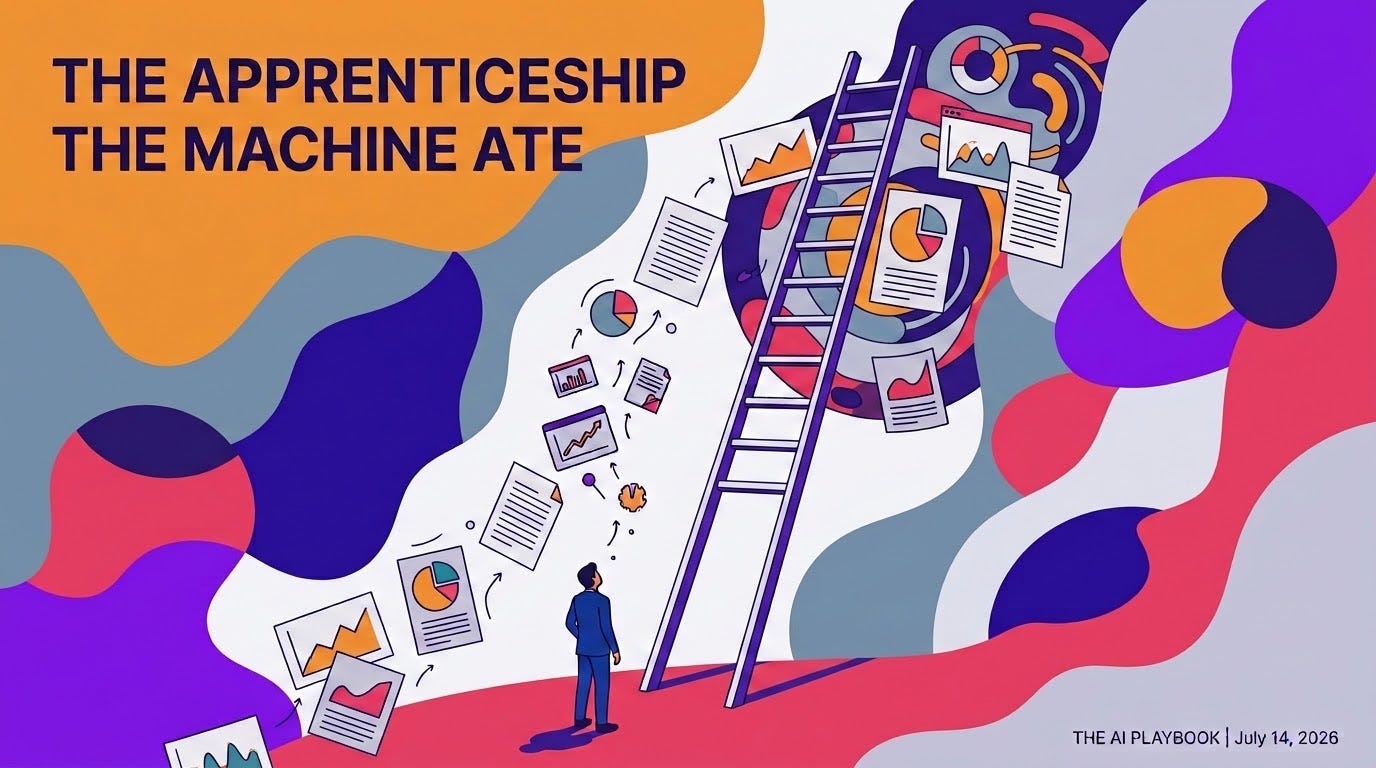
Those reps are disappearing. AI now writes the first draft, ties the reconciliation, and assembles the deck—absorbed precisely because the work was routine. What nobody priced into the automation case: the routine work was the apprenticeship.
Most executives still treat entry-level hiring as the safest line to trim when AI absorbs the routine work. The research that converged this spring says the opposite: it is the most expensive cut on the books—the bill just arrives years late, on the senior bench. In The Judgement Premium16 I argued that judgment is the capability your AI investment gets priced against; in The Sophistication Gap17, that few workforces have built it. This Call is about the supply side: the system that manufactures judgment is collapsing, and what you rebuild now decides who runs your company in 2035.
📬 Hi, I’m Paola. Each week I turn the latest AI-adoption research into ready-to-implement plays you can hand your leadership team—an operating system for competitive advantage that compounds.
Why entry roles now demand the judgment they used to teach
PwC has been a throughline in these Calls—its AI Performance Study anchored The Sophistication Gap17 a month ago. This month a different PwC instrument, the 2026 Global AI Jobs Barometer—more than a billion job ads across 27 countries—supplies the evidence1: postings for AI-exposed entry-level roles are now seven times more likely to demand senior-level skills. “Seniorised” entry-level postings have grown 35% since 2019 while other entry-level postings shrank 10%1. PwC’s global workforce leader Pete Brown names the mechanism plainly: “AI is removing some of the routine work that once acted as an apprenticeship, while increasing demand for judgement, leadership and adaptability much earlier in careers.”1
Put those numbers together: the career ladder still exists, but its bottom rung has been rebuilt at senior height. I call it The Seniorized Rung—the entry level now demands on arrival the judgment it used to exist to build. No one designed this; it emerged, posting by posting, as AI absorbed the routine tasks.
The hiring data shows how quietly it rose. Harvard researchers studying 62 million workers across 285,000 firms found that after companies adopted generative AI, junior employment fell 7.7% within about six quarters relative to non-adopters, while senior employment held steady2. The mechanism was a hiring slowdown, not layoffs: the door is not slamming shut, it is quietly not opening in the first place.
AI did not just automate the junior work. It dismantled the training ground where senior judgment was always quietly made.
The posting mix agrees. Entry-level roles were 44% of U.S. job postings in 2023; by this March, 38.6%3—down 5.4 points in two years, roughly an eighth of the entry-level share. ZipRecruiter reads its report as a graduate market improving—on cyclical measures it is; the share shift is the structural signal underneath. The entry level, increasingly, has no entry.
The debt that matures when no one is manufacturing seniority
The cost of the missing rung does not land in this year’s hiring plan; it lands on a delay, which is why it goes unpriced. I call the liability Apprenticeship Debt: the cumulative gap between the junior intake your future senior bench requires and the intake you are actually making. It compounds every quarter you under-hire and matures, by our estimate, eight to fifteen years out—the balance-sheet mirror of the Human Dividend, the liability you book when you stop investing in human capability.
Jeff Raikes—who ran Microsoft’s Business Division and later the Gates Foundation—named the cost in April: companies cutting entry-level roles are doing it “before they have a talent debt coming due,” and that “the days are numbered for any company that doesn’t develop a human talent pipeline with the judgment to direct it.”4 Pricing that debt takes three numbers your CHRO can pull this week:
1. Management is 7.2% of the U.S. workforce5—the senior layer every AI strategy assumes will be there to direct it.
2. That layer renews almost entirely from below. Promotions into management run at roughly 6.5% a year, back at their pre-pandemic pace, per ADP payroll data6.
3. The bench is already thin. DDI finds only 49% of key roles can be filled from the internal bench, and just 20 % of HR leaders say they have ready successors for critical positions7.
Hold those three numbers together. Cutting the entry cohort does not shrink a cost line; it shrinks the only pool your promotions draw from.
If AI absorbs every rep that taught your people how to decide, who directs the machines your strategy is betting on?
The market is already pricing the scarcity. The same Barometer finds AI-skilled workers command a 62% wage premium, up from 57% a year earlier1. Stanford’s payroll data shows employment for 22-to-25-year-olds in the most AI-exposed occupations down 16% in relative terms since late 20228. Brookings and Yale’s Budget Lab caution—fairly—that the aggregate data shows no AI jobs apocalypse yet9 10. The risk stands anyway: the damage is to a stock that takes a decade to rebuild, and by the time the signal clears, the missing cohort is unrecoverable.
The first invoice already carries a date: Gartner predicts that supply-chain organizations pausing entry-level hiring for AI will face higher costs by 203011. The deeper invoice is our own projection: junior intake began thinning around 2023, and the climb from entry role to seasoned senior runs eight to twelve years—placing the first missing cohort in the early 2030s. The Playbook gives you the calculation to run on your own attrition data.
A bottom rung set at senior height produces no one to promote. The Seniorized Rung is where succession quietly breaks.
What copilots compress, and what judgment still requires
The strongest objection first: AI will train the next cohort faster than it displaced the old one—simulators, copilots, instant feedback on every draft. Ethan Mollick, who taught a generation of executives co-intelligence, now describes an era of “co-existence” with agents that work increasingly on their own12. If the machine can coach every junior individually, the apprenticeship did not die—it got an upgrade.
Here is what it compresses away. AI shortens task-execution time. Judgment forms through consequential reps—decisions with real stakes, owned outcomes, and feedback that arrives with your name attached. The World Economic Forum calls these “judgement loops,” and warns that stripping them out of entry-level work is quietly building a five-year leadership-pipeline crisis13. A copilot can grade a junior’s draft in seconds; it cannot make her defend a recommendation to an impatient client, or be wrong in a way she has to repair. And the more autonomous the agents, the higher the judgment bar rises for the human who directs them. The tool that looks like the trainer is the thing that removed the training.
When AI absorbs the practice reps, the 62% premium for judgment stops being a cycle and becomes the market’s permanent shape.
The rebuild: put your juniors on the review side of the AI
The rebuild starts from one design principle: entry-level roles are no longer cheap production labor to automate—they are judgment-formation roles. Put the junior on the review-and-direction side of the AI, not the produced-output side. The first-year hire who verifies, challenges, and directs AI output accumulates exactly the reps the automation removed: evaluating work she did not produce, owning the call on whether it ships, and carrying the consequences.
One firm has already engineered for this. Law firm Fredrikson & Byron is rebuilding associate development around AI supervision: Chief Legal Operations Officer Norah Olson Bluvshtein described three tactics to Thomson Reuters, including a “formalized curriculum around effectively and efficiently supervising AI output”—teaching young lawyers to direct the machine rather than compete with it14. The honest caveat: it is a stated goal for the year ahead, a designed rebuild rather than a finished one. The blueprint is the point—the firm treated the collapsing on-ramp as an engineering problem while its peers cut the rung and hope seniority appears by other means.
The early returns favor the builders. The same Barometer separates firms that use AI to amplify their people from firms that use it primarily to automate them: the amplifiers show 163% higher productivity growth and grew headcount 52%1. That is the compounding return: developmental investment on people, paying back through the mechanism The Judgement Premium16 priced—judgment that turns tools into results.
The institutions named the drought. None of them built the well. The apprenticeship layer is yours to engineer.
When the entry-level hiring plan reaches your desk, the number in the deck will be cohort cost. The number that belongs on the table is supply: whether the company is still manufacturing the judgment the strategy depends on. SHRM puts the same point in CHRO language—the real multiplier on AI at work is human leadership and judgment15. This decision gets made this quarter, or it gets made for you, by attrition.
The machine ate the apprenticeship. Rebuilding it is no longer an HR program—it is the operating decision that compounds.
Somebody once handed you the deck nobody wanted, and it made you. Handing it back—redesigned—is how the next generation gets made. How to measure that rebuild is territory for a coming Call.
The AI Leadership Playbook
Strategic Questions (copy-paste ready for an email to your CFO and CHRO)
Since 2023, how many of our entry-level roles were cut or left unfilled because AI absorbed the routine work—and how much smaller is the pool our senior promotions will draw from in 2030? Who owns building that leadership bench now?
Our AI tools now produce the first drafts our junior people used to learn on. Where in our company does a first-year employee still make decisions with real stakes—and if the answer is nowhere, which role do we redesign first?
AI-skilled talent already commands a 62% wage premium. What will it cost us to buy senior judgment on the open market in 2030 versus manufacturing it internally—and which function do we model first?
Your Next Plays (copy-paste ready for an email to a direct report)
Price our Apprenticeship Debt. Apprenticeship Debt is the gap between the junior intake our future senior bench requires and the junior intake we are actually making. Pull our senior headcount and annual senior exit rate; multiply for replacement demand. Divide by our historical junior-to-senior conversion rate for required intake. Compare with actual intake since 2023, and date the year the gap reaches the senior bench. Bring the number, not a narrative.
Move one entry role to the review side of the AI. Take one function’s entry role and rewrite it so the junior verifies, challenges, and directs AI output—with named decision rights and outcomes they own—instead of producing the drafts the AI now writes. The goal is judgment formation: reps with real stakes, not shadowing.
Audit where judgment actually gets practiced. Inventory the tasks that used to build judgment in our function—first drafts, reconciliations, client debriefs—and mark which ones AI has absorbed. For each absorbed task, name what replaced it as a practice rep. Where nothing replaced it, that is a gap; assign each gap an owner.
📅 Book a complimentary 1:1 Strategy Session—45 minutes to start that conversation about your AI transformation sequence.
📬 Free preview ending soon. Subscribe to continue getting decision-grade AI intelligence that prepares you to move before your competitors do. First 100 subscribers receive bonus content. Subscribe to The AI Playbook.
Sources
9. Brookings, Molly Kinder (2025)—”New data show no AI jobs apocalypse—for now.”
12. Ethan Mollick, “Co-Existence and the End of Co-Intelligence” (One Useful Thing, Jun 4, 2026).
15. SHRM—”AI’s Real Multiplier at Work: Human Leadership and Judgment.”
17. CognivaLab, The Sophistication Gap (Jun 9, 2026)—adoption vs. sophistication; the 75-point gap.