

The dashboard is green. Eighty percent of the company has an AI license, the rollout slide says “complete,” and at the all-hands someone calls it the fastest tool adoption in the company’s history. Then the CFO opens the quarterly model, and the AI implementation line has not moved a single number that matters. Not revenue per employee. Not gross margin. Not cycle time on anything the board tracks. The tools are everywhere; the P&L is exactly where it was before.
Most leaders read that as a timing problem—adoption is high, the returns are coming. It is not a timing problem. It is a measurement problem. The dashboard counts who has access to AI. It does not count who has changed how the work gets done. Those are different numbers, and the distance between them is where the investment quietly disappears.
Last week, in The Judgement Premium, I priced the judgment behind the five percent—the employees who frame the problem and direct the model rather than shave a few minutes off a task. KPMG and the University of Texas at Austin reached that figure by analyzing 1.4 million real workplace AI interactions: roughly five percent of users engaged AI with genuine sophistication1. This Call is about the other ninety-five percent—how you move them, why that becomes a moat no competitor can buy, and what it costs you if you do not.
📬 Hi, I’m Paola. Each week I turn the latest AI-adoption research into ready-to-implement plays you can hand your leadership team—an operating system for competitive advantage that compounds.
Adoption is the metric that hides the failure
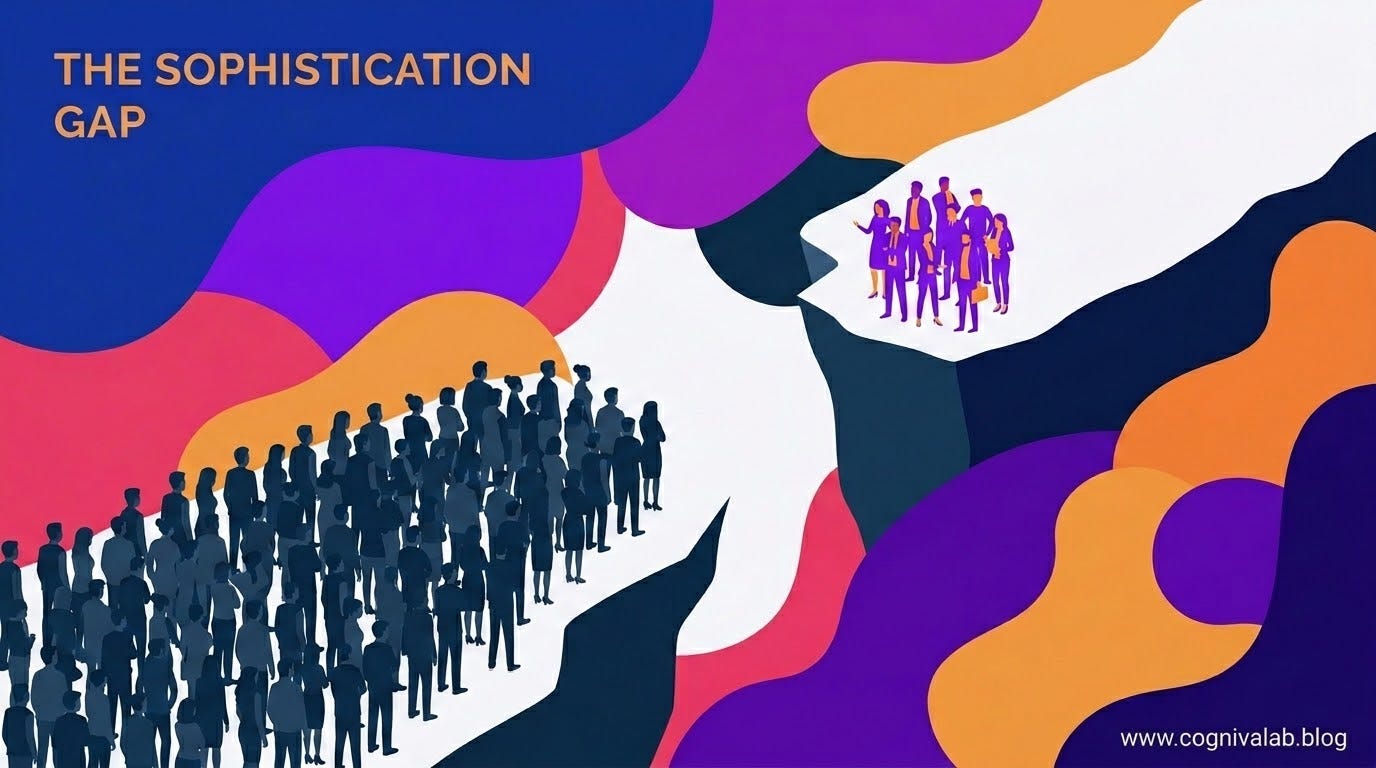
Let’s give the disparity its proper name. The Sophistication Gap is the discrepancy between the share of your workforce with access to AI and the share that uses it to rebuild how the work gets done. Adoption is a headcount; sophistication is a capability. You can buy the first. You have to build the second. Closing that gap is not a training nicety—it is the precondition for any AI return at all, and it is the work AI-transformation leaders are accountable for.
Adoption is the number that makes a board comfortable. Sophistication is the number that makes the AI investment valuable.
The cost of buying the tool and starving the people who hold it
Researchers at MIT’s NANDA initiative put a figure on the failure. After thirty to forty billion dollars of enterprise spend, roughly ninety-five percent of generative-AI pilots show no measurable impact on the P&L; about five percent break through2. The NANDA researchers are blunt about the culprit: not the model—the “learning gap,” the failure to integrate AI into workflows, structures, and culture. Set that beside the workforce number and the pattern is hard to miss: about five percent of pilots return gains, in a workforce where about five percent use the tools with any sophistication. Two different studies, two different denominators—the same root cause wearing two faces.
Ninety-five percent of pilots never move the P&L. They do not fail on the model. They fail to operationalize the transformation, not just the adoption.
Then the spending mismatch. Fortune reports AI infrastructure spend is set to rise forty-four percent this year while training budgets grow five percent, and average learning time per employee is falling—from forty-seven hours to forty3. A company spending forty-four dollars on the tool for every five it spends on the person holding it. As I argued earlier this year in Our Humanity Is the Moat, powerful tools in untrained hands do not build a moat; they build expensive conformity.
The board will not wait quietly for this to resolve itself. Only twenty-nine percent of organizations report meaningful return on generative AI4, and three-quarters of the economic gains have accrued for a fifth of companies5. When the AI line on the P&L stays flat through two earnings calls—booked as cost quarter after quarter, never as the margin gain the deck promised—the question stops being technical and becomes existential: what happened to the investment? The executive team that bought tools without building sophistication will not have an answer to give.
If only five percent of your people use AI to rebuild the work, what is the other ninety-five percent of your AI budget actually buying?
Why sophistication is the moat a competitor cannot buy
The tools are commodities. A competitor can license the same models by Friday. What a rival cannot license is a workforce that has spent a year learning to rebuild the work around those models—and that is what sophistication compounds into. Two companies show the shape of it.
Moderna did not release AI tools and assumed employees would use them at all, let along with any degree of sophistication. It put ChatGPT Enterprise in every employee’s hands and asked them to build. Within two months, staff had created more than 750 custom GPTs; the average user now runs roughly 120 AI conversations a week; entire functions reached full adoption6. That is what a concrete mandate coupled with a culture of experimentation achieved. The workforce transformation is the obvious win. The deeper gain is structural: a scientist or a lawyer who builds the tool that reshapes their own job is no longer performing a role AI might take—they are authoring one AI cannot perform alone.
DBS, Singapore’s largest bank, turned that into a number a board reads. Its AI work is scaling toward a billion Singapore dollars in economic value, built on roughly thirteen thousand employees required to complete structured AI and data training—and it is adding AI roles instead of cutting employees loose7.
Models depreciate the day a better one ships. The workforce that learned to wield them appreciates. Sophistication, engineered across a workforce, shows up as capital.
Pull the threads together and the moat runs in four directions, none replicable by a purchase order.
Productivity and innovation compound across the entire workforce instead of a sliver of it.
Talent retention increases. The employees every rival is bidding for rarely leave for a bigger salary—they leave for a bigger role. The organization that has redesigned work, workflow, and enablement around sophistication is the one that can offer the role no competitor can match; with the autonomy and scope that come attached.
EBIT expands (operating profit before interest and tax). That’s the margin line a board can track quarter over quarter.
Competitive advantage becomes durable precisely because it is structural—not a tool you switched on, but the way you leveraged AI to redesign how work gets done with higher speed and accuracy.
You cannot pay your best people to stay. Give them work only a sophisticated human-plus-AI can do—and no rival can match the role.
The fix is structural, not tied to a training budget
The reflex is to buy more training. The research is clear that training alone will not bridge the gap—coursework raises awareness, not sophistication. What bridges the gap is a redesign of how the work is done, and it has three moves:
Track AI sophistication. Retire the adoption dashboard and stand up a sophistication metric in its place, reported where the seat count used to live. What share of each team has redesigned a workflow around AI this quarter? How many roles have been re-written for AI-human collaboration? Define and track the metric that’ll move the needle in your specific context.
Redesign the work itself. Make task restructuring and workflow redesign around AI capabilities the core goal of your AI implementation. Shopify made the lever explicit: reflexive AI use is a baseline expectation, written into performance and peer reviews8. And before any new headcount is approved, the manager must prove the work cannot already be done with AI—so the team redesigns the role before it grows it.
Reinvest the AI dividend to compound efficiencies. Your organization’s AI dividend is the time and efficiency you gain once workflows and roles are restructured around AI. Rather than banking it as a one-time headcount cut, reinvest the gain into continuous improvement led by the employees who turn the tools into capability in the first place. That is your Human Dividend—and it is your deepest competitive moat.
Monday morning, your dashboard will show you adoption. Before the next board meeting, ask the harder question: what is our sophistication metric, who owns moving it, and what did it improve last quarter? The company that can answer is already pulling away from the one still admiring its license count.
Everyone bought the same AI stack. The winners rebuilt the work—and the roles—around the people who use AI best.
You have the data and the playbook now. The license count was the easy part; building the workforce behind it is the work that actually compounds—this quarter, and the one after.
The AI Leadership Playbook
Strategic Questions (copy-paste ready for an email to your CFO and CHRO)
We can see our AI adoption rate. What is our sophistication rate—the share of each team that has redesigned an improved workflow or role to maximize AI investment this quarter—and who is accountable for it?
For every dollar we spend on AI tools and infrastructure this year, how many cents are we spending on the people we expect to turn those tools into capability—and what does that ratio need to become?
If the board asks on the next earnings call what our AI investment moved on the P&L, what is our answer today? What is the first workflow we will redesign so the answer is better next quarter?
Your Next Plays (copy-paste ready for an email to your leadership team)
Replace the adoption dashboard with a sophistication scorecard. Define one concrete unit—for example, workflows redesigned for efficiency around AI capabilities, per team—and give the metric to an owner who reports it alongside the financials.
Redesign the role, not just the toolkit. Take the three highest-cost workflows in one function and commission a redesign that builds AI into the role itself; make the people who do the work the ones who build the redesign.
Write AI sophistication into the employee performance review process. Add an AI-sophistication expectation to performance and peer reviews, rated by managers and peers, so building capability stops being optional and becomes the job.
—
📅 Book a complementary 1:1 Strategy Session—45 minutes to start that conversation about your AI transformation sequence.
📬 Free preview ending soon. Subscribe to continue getting decision-grade AI intelligence that prepares you to move before your competitors do. First 100 subscribers receive bonus content for the life of their subscription.
Sources
Fortune (Mar 2026)—AI infrastructure spend +44% vs training +5%; learning time 47→40 hrs/employee.
WRITER, Enterprise AI Adoption 2026—only 29% of orgs report meaningful GenAI ROI.
PwC, 2026 AI Performance Study—75% of AI economic gains captured by ~20% of companies.
Moderna × OpenAI case study—750+ employee-built GPTs in ~2 months; ~120 AI conversations/user/week.
DBS × Google Cloud—AI value scaling toward S$1B; ~13,000 employees trained; adding AI roles.
Shopify—Tobi Lütke AI memo (First Round)—reflexive AI use written into performance + peer reviews.
The Human Dividend, “Our Humanity Is the Moat” (CognivaLab)—coined “expensive conformity.”