

Three research shops looked at the AI productivity question this year. Bain measured what showed up after a deployment. Prosci measured what change-management money actually delivered. Gallup measured the manager. Three different angles. One cohort kept showing up in the data.
I call this cohort the Translation Layer. It is the human work in the middle of an org that turns AI tools into changed workflow, changed capability, and changed output. Without it, the tools sit on top of the same routines that ran the company before the tools arrived. With it, the tools compound.
Most companies are funding that layer at zero — and reporting flat AI ROI to their boards.
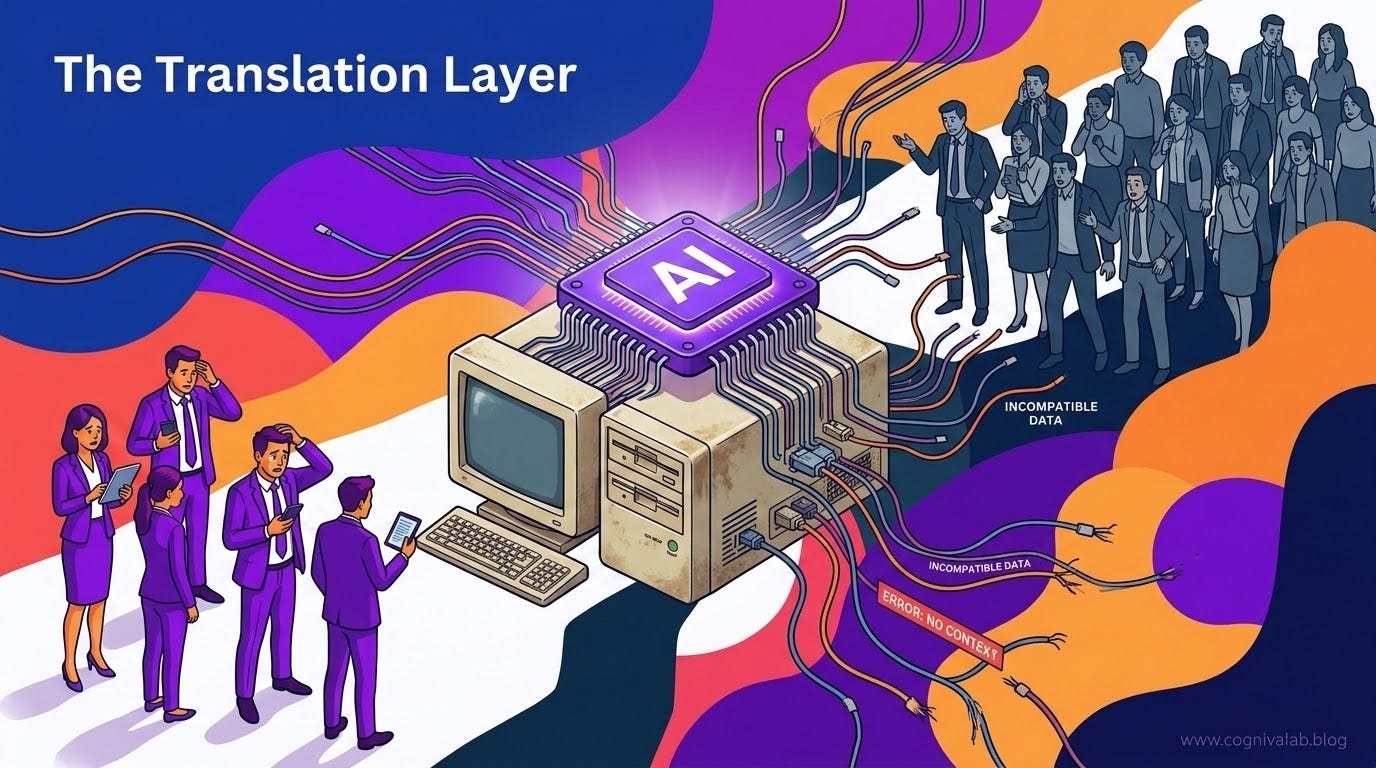
AI without the Translation Layer is a Ferrari engine bolted to a 1990s chassis. The horsepower is real. The platform can’t carry it.
Where the premium actually sits
Start with Bain. Their 2025 read on AI-in-production puts the productivity gain at 10–15% when companies deploy the tools alone. The figure jumps to 25–30% when companies pair the tools with end-to-end workflow redesign.¹ Same tools. Same vendors. Same models. Double the output.
The differentiator is what most boards are not funding: the human work that sits between the tool and the team. Redesigning who does what. How decisions get made. How the team’s day actually changes when AI shows up inside the workflow. That work happens at the team unit — which means it has to be done by the person who runs -that unit;In other words: the middle manager.
Now layer Prosci on top. Their 2025 best-practice benchmark for change-management investment is 10–15% of the total program budget.² Most companies fund that line below 5%. Some fund it at zero. The premium Bain measures is exactly the work the Prosci benchmark is asking you to fund — manager development, workflow redesign, and team-unit experimentation – the line that converts a tool license into actual adoption. If you cut that line, you cut the premium with it.
Here is how a CFO should read that pairing: every dollar redirected from tooling to translation captures roughly three dollars of incremental productivity. Not as a precise multiplier — as a directional one. The math is consistent across the dataset. The line item is consistent across the companies that miss it.
The cohort that captures the premium
Then Gallup. Their 2025 global engagement study landed two findings worth sitting with.³
First: manager engagement is at a multi-year low. The cohort responsible for translating strategy into team routine is the one most disengaged with their own work. Female managers fell another seven points further still. Whatever the AI rollout asks of this cohort, the cohort is showing up to the ask running a deficit.
Second — and this is the one to mark: where the manager actively supports the AI rollout, employees are 8.7 times more likely to report that AI changed how much work gets done. Not 8.7 percent. 8.7 times. Whatever the AI premium looks like in the data, this cohort is the gate.
Sit with that arithmetic for a moment. Bain says the workflow redesign is where the premium lives. Prosci says the redesign requires a real change-management line item. Gallup says the manager is the cohort that converts the line item into actual adoption. The three sources point at one person. That person, in most companies right now, is under-resourced, under-engaged, and on the list of cuts.
The manager is not a soft variable. The manager is the multiplier.
Develop before you delayer
The flat-org thesis is real. A serious chunk of middle management is administrative — meeting forwarder, status compiler, budget approver — and AI agents will absorb that work fast. That part of the layer should compress.
But the same layer also contains the people who can do the workflow translation. The two functions are sitting in the same headcount line, often inside the same job description. If you cut the headcount before you separate the two functions, you keep the middle-management workflow translator inside the cuts instead of engineering this critical layer out of the org chart by accident.
Bezos used to describe his job as keeping the company two sizes smaller than it should be. The Translation Layer sits inside the size you keep. It is not the bloat. It is the load-bearing wall.
The maxim: develop before you delayer. Identify the managers who can run the translation work. Move them off the administrative load. Give them the budget and the authority to redesign workflow at the team unit. Let the AI agents automate the rest. That is how you absorb the AI transition shock without losing the premium.
The Translation Layer is not the bloat. It is the load-bearing wall.
The Translation Layer premium
Buffett once described the difference between a good business and a great one as the spread between what the business earns on its capital and what its cost of capital actually is. The Translation Layer is the same spread, applied to AI.
Two companies buy the same enterprise license. Same vendor. Same seats. Same training program. Company A drops the tools into the existing workflow and reports a 12% productivity bump to its board. Company B identifies the managers already running the translation work, gives them a budget line for workflow redesign, and reports 28% productivity.
The spread between 12 and 28 is the Translation Layer premium. It is not a model upgrade. It is not a vendor swap. It is the same dollar, redirected to the cohort that knows how the work actually moves through the team.
That premium has a cohort attached to every percentage point. Once you can name the cohort, you can fund it.
📅 The leaders treating this as their Q2 reset are booking a 45-minute Strategy Session to map the redirect. → Book here.
The Playbook
Three Questions
1. What is our current AI-program budget split between tooling, training, and workflow translation? And who owns middle-management workflow redesign?
The Bain + Prosci pair predicts what the productivity number will be once you have the answer. If translation is below 10% of the program and no one owns it, the gap to the 25–30% premium is structural, not tactical. What do we change first?
2. Which of our managers have been trained on AI tools — not just given access? Is the AI productivity metric higher for those teams?
Deloitte’s 2026 enterprise read⁴ shows access is not the bottleneck. Daily-use is. The Gallup 8.7× multiplier sits inside the manager-trained cohort. If our number is below the benchmark, the deficit is in capability, not in licenses. Who runs the capability fix?
3. If we redirected 20% of next quarter’s AI tooling budget to deploy AI tooling and workflow translation at the team-unit level, where would the first commitment go? Which team is closest to a measurable workflow win?
Pick the team where the line manager is engaged, the workflow is well-mapped, and the metric is already on the board. That is where the premium will show first. What does the first month look like?
Three Plays
Play 1 — Name the Translation Layer. Identify the managers in your company who already do the workflow-translation work. Selection criteria: they are running the teams where AI rollouts have produced something other than a flat productivity number. They are the Translation Layer. They hold the key to the productivity opportunity for every AI deployment that follows.
Play 2 — Move the line item. In your next AI program review, propose a redirect of 5–10% of the tooling budget to a Translation Layer line. Earmark it for workflow redesign, manager development, and team-unit experimentation. Name the owner.
Play 3 — Run a Translation Layer pilot. Pick one team. Give the manager the budget, the authority, and the workflow-redesign brief. Measure the productivity delta against a comparable team running the same tools without the redesign. The delta is the conversation you bring to the board.
More strategic plays in the weeks ahead. For now, road test these with your teams and tell us how it goes in the comments.
• • •
📬 Free preview ending soon. Subscribe to get decision-grade AI intelligence that prepares you to move before your competitors do. First 100 subscribers receive bonus content.
Subscribe → www.cognivalab.blog
• • •
Sources
1. Bain & Company, Technology Report 2025: AI Leaders Are Extending Their Edge — productivity gains of 10–15% with AI tools alone vs. 25–30% with AI tools paired with end-to-end workflow redesign. https://www.bain.com/insights/topics/technology-report/
2. Prosci, Best Practices in Change Management — 12th Edition — change-management investment benchmark for premium-grade adoption; organizations executing excellent change management see an 88% project-objective success rate vs. 13% for those with poor practice. https://www.prosci.com/blog/change-management-best-practices
3. Gallup, State of the Global Workplace 2025 — manager engagement at a multi-year low; female managers fell another seven points; employees are 8.7× more likely to report AI changed how much work gets done where the manager actively supports the rollout. https://www.gallup.com/workplace/349484/state-of-the-global-workplace.aspx
4. Deloitte, The State of AI in the Enterprise 2026 — workforce access to AI tools has expanded to ~60%; among workers with access, fewer than 60% use AI in their daily workflow. https://www.deloitte.com/us/en/what-we-do/capabilities/applied-artificial-intelligence/content/state-of-ai-in-the-enterprise.html
• • •
Paola Sanmiguel is the founder of CognivaLab, an AI Transformation advisory practice for executives leading AI integration without losing the human capability that compounds it. The AI Playbook lands every Tuesday at www.cognivalab.blog.