

I have heard several CEOs say some version of the same thing in the last six weeks: We moved fast on AI. And then a pause. Followed by: We’re not seeing the returns we expected.
They are not wrong. PwC’s 2026 AI Performance Study surveyed 1,217 executives across 25 sectors and found that 74% of AI’s economic value is being captured by just 20% of companies. The other 80% are deploying the same tools, spending the same budgets, and getting almost nothing back. The performance gap between AI leaders and laggards is now 7.2x.¹
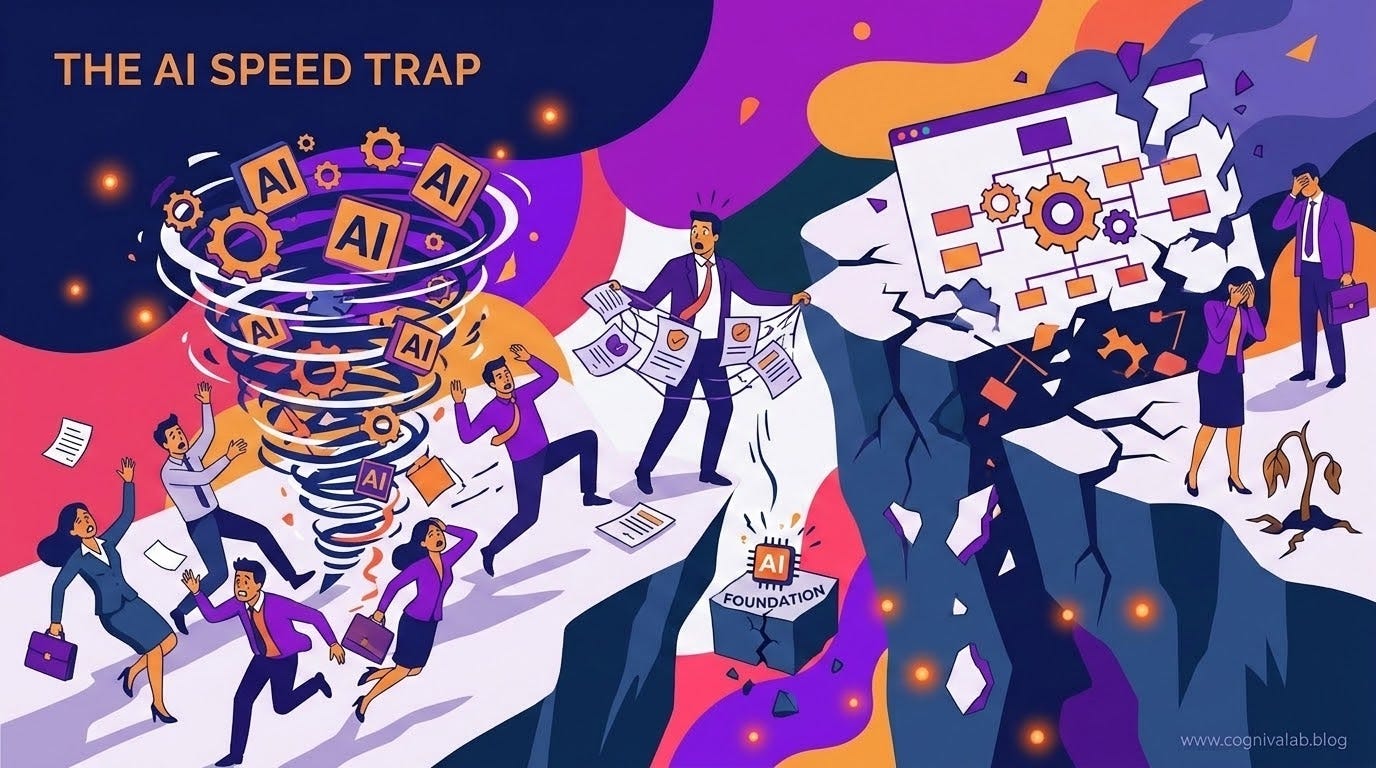
The instinct in most American boardrooms is to read that number and accelerate. Move faster. Deploy wider. But the data says the opposite. The 20% who are winning did not move faster. They moved differently. PwC found that 80% of any AI initiative’s value comes not from the technology itself, but from redesigning how people work with it.
Eighty percent of AI’s value lives in how people use it—not in the technology itself. Most companies are fighting over the other twenty.
What the Rest of the World Already Knows
Outside the U.S., the conversation sounds fundamentally different. Not slower—more structural.
A European Investment Bank study of more than 12,000 firms across the EU and the United States found that AI adoption increases labor productivity by roughly 4%—driven by capital deepening, not job cuts—but only when organizations make complementary investments in software, data infrastructure, and workforce training.² The productivity gain is real, but it is conditional. Skip the human investment and the gain evaporates.
Germany’s codetermination system—where works councils have legal authority to shape how AI is deployed in the workplace—is producing measurably better outcomes. A 2026 study in Work and Occupations found that German firms where workers were consulted on AI deployment reported stronger adoption and better working conditions than firms where technology was imposed from the top.³ OECD evidence confirms the pattern: workers consulted about new technology are significantly more positive about AI’s impact on their work—and positive workers adopt faster.
Singapore made workforce transformation a government mandate. Its 2026 budget created a single statutory board—one agency with legal authority over both workforce training and career services—so that AI readiness moves at the speed of policy, not bureaucracy. Every citizen gets AI readiness diagnostics; workers over forty get up to $4,000 in retraining credits. South Korea committed $960 million to a lifetime AI talent development plan.⁴ These governments are not waiting. They are building capability first.
Japan frames AI transformation through an entirely different lens. With a working-age population shrinking by 600,000 people per year, AI is not a displacement threat—it is the only plausible way to maintain economic output.⁵ Even under that urgency, Japan’s Society 5.0 framework prioritizes workforce education and collaborative AI design—not replacement.
Four countries, four different urgencies—and the same conclusion: capability first, technology second.
The Pattern Underneath
Three continents. Different regulatory traditions, different labor markets, different urgencies. And the same conclusion: the organizations producing real value from AI are the ones that invested in human capability before they scaled the technology.
McKinsey’s State of Organizations 2026 puts a ratio on it: for every dollar spent on AI technology, five dollars should go to reskilling, workflow redesign, and change management—the organizational infrastructure that makes technology produce returns.⁶ A company increasing AI infrastructure spend by 44% while the enablement budget grows 5% is not underinvesting. It is engineering its own failure.
Stanford’s 2026 AI Index confirms what that failure looks like at scale: organizational adoption has reached 88%, but the Foundation Model Transparency Index dropped 31% in a single year and documented AI safety incidents rose 55%.⁷ Speed without structure does not produce transformation. It produces expensive conformity—organizations adopting the same tools, in the same way, producing the same middling results while the governance infrastructure collapses underneath.
Where the Leverage Actually Lives
The U.S. conversation frames this as a speed problem: who can deploy AI fastest wins. But the global evidence says it is a sequence problem. The winning organizations—in Berlin, in Singapore, in the 20% PwC identified—are not moving slowly. They are moving in the right order: people first, then technology. More on each of these strategies in the weeks ahead.
Psychological safety before automation. Capability investment before tool deployment. Redeployment before replacement.
For today, here’s the crucial nugget: sequence is not a luxury of European labor law or Asian government subsidies. It is a strategic discipline available to any leader willing to resist the pressure to deploy first and figure out the human side later.
The question I keep bringing back to the executives I work with is this: are you building the capability of your people to meet the capability of your tools? Because if the answer is no, the tools are not your competitive advantage. They are your most expensive line item.
AI Leadership Playbook
Essential AI Leadership Questions
For every dollar we are spending on AI infrastructure, how much are we investing in the people who will use it? Is the ratio anywhere close to 5:1—enablement to infrastructure?
Were our teams consulted on how AI would change their workflows, or were they informed after the decision was made? What’s the adoption gap between those two groups?
If we sequenced capability investment before the next technology deployment—reskilling, workflow redesign, change management first—what is the first change we have to make?
AI Leaders Next Plays
Pull our AI infrastructure spend and our workforce enablement spend for the last two quarters. Put them side by side. Calculate the ratio and send it to me. If we’re not at 5:1 enablement-to-infrastructure, flag the gap and what it would take to close it? How long would it take?
Before we approve the next AI tool purchase, I want a one-page workflow redesign proposal from the requesting team. ROI is driven by changes in how people work—not just adding technology.
Ask each of your direct reports this week: were your teams consulted on how AI would change their work, or were they told after the fact? I want the answer—and the adoption numbers for each group.
If you are working through the question of how to sequence your AI transformation—where to invest in your people, how to redesign work so AI and your teams perform at their best together—that is exactly the conversation I help leaders navigate.
📅 Book a complementary 1:1 Strategy Session — 45 minutes to discuss your AI transformation sequence.
📬 Free preview ending soon. Subscribe to get decision-grade AI intelligence that prepares you to move before your competitors do. First 100 subscribers receive bonus content.
#LeverageAI #RedeployBeforeReplace #GoSlowToGoFast #AITransformation #FutureOfWork #EnterpriseAI
Sources:
¹ PwC. “2026 AI Performance Study.” PwC Global, April 2026. pwc.com/gx/en/issues/technology/ai-performance.html
² European Investment Bank. “AI Adoption, Productivity and Employment: Evidence from European Firms.” EIB Working Paper 2026/02, January 2026. eib.org/en/publications/20250383-economics-working-paper-2026-02
³ Doellgast, V., Kämpf, T. & Langes, B. “Building Worker Voice and Power in AI Decisions: Three Cases in the German ICT Industry.” Work and Occupations, 2026. doi.org/10.1177/07308884251412886
⁴ Singapore Budget 2026, Ministry of Manpower / SkillsFuture Singapore, February 2026; Republic of Korea, “AI Talent Development Plan for All,” 2025. mycareersfuture.gov.sg/budget-2026
⁵ Tech for Impact Summit. “The Future of Work: Human Talent, AI Agents, or Post-Work Society?” 2026. tech4impactsummit.com
⁶ McKinsey & Company. “The State of Organizations 2026: Three Tectonic Forces.” McKinsey, March 2026. mckinsey.com/the-state-of-organizations
⁷ Stanford Institute for Human-Centered Artificial Intelligence. “The 2026 AI Index Report.” Stanford HAI, April 2026. hai.stanford.edu/ai-index/2026-ai-index-report