On Tuesday morning, Brian Armstrong sent 700 Coinbase employees a 6:55 a.m. email cutting their jobs and naming the company’s new architecture in the same breath: lean, fast, AI-native, no more than five layers below the CEO, managers replaced by player-coaches1. The same week, Hayden Brown wrote a similar note to Upwork—145 jobs, 24% of headcount, the third workforce reduction in three years. That day Upwork’s stock went down 19.3%2. Days later, Mark Zuckerberg told 8,000 Meta employees their May 20 separation was a line item in his $145 billion AI bill3.
The AI layoff wave is real, and it is accelerating. The Federal Reserve Bank of Atlanta and Duke University surveyed 750 CFOs and senior corporate executives in March 2026 and found that the executives reported AI-driven productivity gains averaging 1.8% in 2025. The same researchers computed the revenue-implied gain using actual revenue and employment data and found 0.6%—about one-third of what the CFOs reported. The 1.2-percentage-point wedge is the ‘productivity paradox’ the working paper documents: CFOs perceive AI gains that the revenue data has not yet confirmed. The National Bureau of Economic Research analysis built on that dataset projects roughly 502,000 AI-driven job cuts in 2026—nine times the 55,000 reported in 20254.
Read that again. A nearly tenfold escalation in AI-driven job reductions in four quarters. That is the macro number my CFO clients are quietly modeling against next year’s headcount line.
On the flip side, as I cited on The Translation Layer Call a couple of weeks back, Forrester is forecasting that half of these AI-attributed reductions will be reversed within 12 to 18 months of announcement—rehired offshore, on contract, or at lower wages, with Gartner putting the cohort at 50% by 202713. Your board read the layoff headlines this week. Your CFO is already modeling the severance line for next quarter’s earnings call. This Call is what to do before the rehires arrive—or how to skip the disruptive and costly cycle altogether.
Why the layoff arrives before the architecture
Eliminating 14% of headcount does not produce AI capacity. Eliminating 25% does not redesign a workflow. The layoffs arriving across tech this month are happening before the work has been re-architected to absorb them—and that sequence is the structural problem fueling the AI layoff wave.
As I cited in The Translation Layer Call15, Deloitte reported in their State of AI in the Enterprise 2026 that 84% of organizations have not redesigned their workflows around AI capabilities14. McKinsey’s State of AI 2025 survey of 1,993 organizations across 105 countries puts the same finding from the inverse direction: only 21% of organizations have redesigned even some workflows; nearly 80% are layering AI on top of processes designed for humans5. Two studies, two methodologies, the same gap. These findings point to a systematic failure to re-architect operations to leverage the transformative power of AI. Layering AI atop existing systems chokes the substrate the integration needs to maximize ROI. When layoffs remove the remaining substrate, AI returns essentially evaporate.
Workflow redesign is what produces the capacity that lets a smaller team carry the same load. Without it, the work done by the people who were laid off does not disappear—it gets redistributed across the remaining teammates, who are now also expected to operate the AI tools, manage the agents, and own the integration risk. Three months in, productivity is flat or down, the AI deployment is parked because no one owns the workflow change, and the same operating leaders who were signing the severance letters are quietly signing recruiter contracts.
This is the part the press releases skip.
The Replace-First Tax is what an executive pays when severance arrives before workflow redesign. The layoffs are real; the AI capacity to backfill is not.
The four costs your CFO can already model
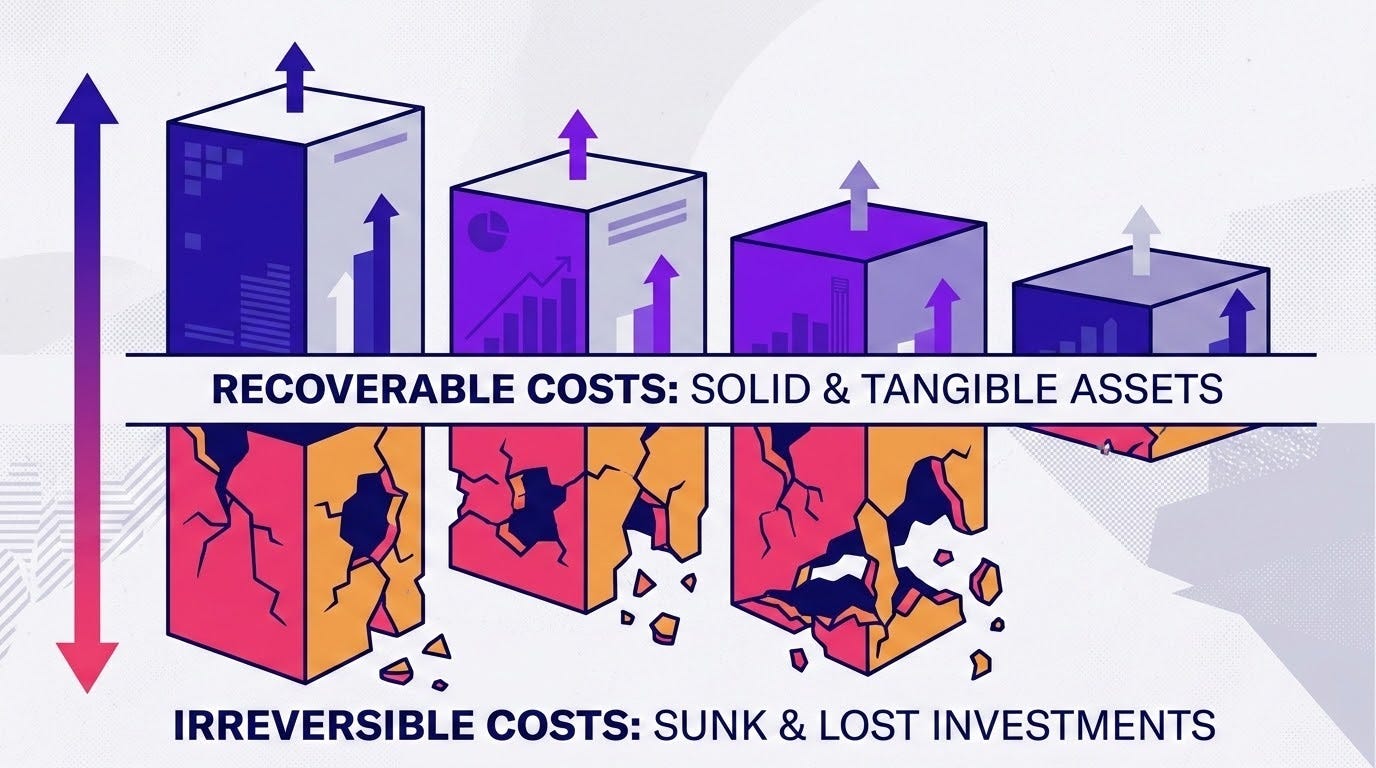
The Replace-First Tax has two layers. The first layer consists of the four recoverable costs that land on the P&L within twelve months—severance, recruiting, onboarding, and the time-to-productivity drag while the rehire ramps. The second layer consists of the two irreversible costs that land on the operating model and stay there. Let’s start with the recoverable layer because it is the case the press release omits, and because it is the layer the CFO can model line by line. The two irreversible costs that follow are the ones the CFO cannot model—and it determines whether the AI integration the layoffs were meant to fund actually delivers a return.
Let’s start with the recoverable costs layer:
1. Severance. The accounting line every CFO sees first. Standard packages run sixteen weeks of base pay plus two weeks per year of service for U.S. tech workers, with health coverage extending twelve to eighteen months. Meta’s May 20 round disclosed exactly this structure for 8,000 employees. The number is large, finite, and forecastable—which is why it lands so cleanly in cost-out announcements.
2. Recruiting. SHRM’s 2025 Benchmarking Report puts the average cost per hire at $5,475 for non-executive roles and $35,879 for executives—up 113% since 2017. For technical roles in tech, the all-in number runs $10,000–$20,000 per hire. When the rehires Forrester forecast begin, this line item runs concurrent to the severance line that triggered it.
3. Onboarding. SHRM’s 2025 onboarding research puts the average direct cost at roughly $4,000 per new hire6. ATD adds $1,280 per employee in annual training and development. Both figures spike for AI-fluent roles requiring platform certifications and proprietary-tool training—the exact roles the rehire pool will need to refill.
4. Time-to-productivity drag. SHRM’s onboarding data show most new employees take six to eight months to reach full productivity; structured onboarding pulls that floor down to four to six months and unstructured environments stretch it to eight to twelve6. Specialized technical roles and middle-management positions extend the window to nine to twelve months; executives often need eighteen. Throughout that ramp the new hire is a cost center: salary is paid, work is partial, and the institutional context the role depends on is still being built. When roles are eliminated before workflows are redesigned, the productive-output clock starts over from zero.
The four costs are recoverable. The executive who runs the math sees a depressed P&L for twelve to eighteen months and an elevated G&A line throughout. The decision was a sequence error, not a value loss—painful, but recoverable on a predictable timeline.
If your AI strategy starts with severance, your CFO is funding the layoff and the rehire—not the AI return on investment.
The two costs that do not appear on the P&L until the AI integration stalls
The second layer’s first irreversible cost is institutional knowledge loss. Inkubit’s research estimates a 30,000-employee organization loses approximately $72 million annually in productivity from undocumented expertise leaving the building7—roughly $2,400 per employee per year. The hidden cost per individual senior departure runs around $430,000 above the recruiting line. For a $5 billion company those numbers are recoverable on a long horizon. For a $500 million company they are not.
Where does that knowledge go? The senior employees who held it take it with them to the next employer. The institutional context—the workflows, the relationships, the unwritten rules of which decisions cross which desks—does not transfer. It vaporizes when the laid-off employees walk out, and the rehire twelve months later cannot reconstruct it from a handoff document. The departing employee is whole. The company is not.
BCG’s Build for the Future 2025 puts the structural number on it: roughly seventy cents of every AI investment dollar depends on workforce capability—the people who hold the workflow context, not the AI model8. The layoff that removes those people removes the workforce capability the AI investment was funded to leverage. The integration does not stall because the technology failed; it stalls because the people who owned the translation layer15 are gone.
The second irreversible cost is the trust layer—and this is the one executives most consistently miss because it lives in employee behavior, not on the P&L. The mechanism is straightforward: AI integration ROI depends on employees voluntarily documenting their workflow context, sharing tacit knowledge, and participating in the human-AI collaboration that makes the integration profitable. When the visible message from leadership is “we will replace you,” the remaining teammates do the rational thing—they withhold the translation layer. They stop sharing the context that becomes the specification for their own replacement.
Mercer’s Global Talent Trends 2026 tracks the rising fear: employee concerns about AI-driven job loss climbed from 28% in 2024 to 40% in 20269. Amy Edmondson’s HBR work on psychological safety in AI contexts confirms what the Mercer numbers imply—without the trust layer, the workflow context AI integration depends on never gets surfaced10. The integration the layoffs were meant to enable depends on the exact context-sharing behavior the layoffs just suppressed. That is not a recoverable cost. It is a foreclosed option.
The company that lays off its workflow architects loses the workflow architecture. The Translation Layer Collapse is what the rehire cannot reconstruct.
The three steps that earn the layoff the right to be called a strategy
Three things have to happen before any AI-justified workforce reduction earns the name.
1. Audit the workflow for actual capacity gain. Pick the function. Walk every step. Identify where AI takes thirty minutes off a four-hour task and where it adds twenty minutes of supervision. Net the result. Without the audit, the capacity “freed” by AI is a forecast, not a finding.
2. Redesign the roles around the new capacity. If a senior analyst now spends 25% less time on synthesis and 25% more on judgment, the role is now different. Promote it; pay it differently; measure it differently. Skipping this step produces the workflow-vacuum effect—the work does not disappear, it becomes invisible, and the remaining teammates absorb it without recognition.
3. Redeploy before you reduce. Map the redesigned roles back to the existing workforce. The people who would otherwise be laid off may already have the institutional context the redesigned work requires—they need permission, training, and a path. If after the mapping the redesigned org needs fewer people, the reduction is now defensible: it followed the architecture, and the institutional context belongs to the people who stay, not the people walking out the door.
The reversal pattern is already showing up in the cases that skipped this discipline. Salesforce eliminated roughly 4,000 customer-support roles after deploying AI; CEO Marc Benioff has said AI agents now handle about 50% of customer interactions. Independent benchmarks put LLM-based CRM agents at 58% success on single-step tasks—meaning roughly four out of every ten complex customer issues escalate or fail outright11. Customer satisfaction scores dropped, complaint volume rose, and the company has been hiring contractors at lower wages since late 2025 to handle the work AI cannot resolve. Klarna ran the same play in 2024 with 700 customer-service workers, watched satisfaction collapse, and rehired humans within twelve months. The pattern is hardening, not new—and the Atlanta Fed’s 502,000-job reduction projection for 2026 means the rehire wave will be visible in the data within four quarters.
A counterargument is worth surfacing here. Coinbase’s stock did gain on its 14% workforce reduction—but it gained on a reduction sequenced after named org-design changes: five layers below the CEO, player-coaches replacing pure managers, AI-native pods. The market priced the org redesign and accepted the headcount reduction as the consequence of the redesign, not the strategy. A workforce reduction announced before the AI role redesign that earned it gets re-rated against the next earnings disappointment, on the schedule the Atlanta Fed and Forrester are both forecasting.
Layoffs that follow AI role redesign compound the savings. Layoffs that precede it return on next year’s recruiting budget.
The decision your CFO will ask for at the next board meeting
This is what go-slow-to-go-fast looks like in the AI-layoff moment. Slow on the layoff. Fast on the redesign. Helen Poitevin, a Gartner VP analyst, named the pattern from inside the institutional research seat last week: “Workforce reductions may create budget room, but they do not create return. Organizations that improve ROI are not those that eliminate the need for people, but those that amplify them.”12 The Atlanta Fed data backs the analyst call. Your CFO will see both numbers before the next earnings cycle—and your board is already asking which side of the projection you intend to be on.
When your CFO asks for a cost-out story and your board asks for an AI ROI narrative, the question is not whether you reduce headcount. The question is whether you have done the architectural work that makes a reduction defensible eighteen months later—and whether the people who can build the translation layer are still in the building when the AI integration needs them.
You can rehire the headcount. You cannot rehire the context that walked out with it.
The AI Leadership Playbook
Strategic Questions
Q1. Which workflows have we actually redesigned to absorb AI capacity, and what would the audit show if we ran it next week?
Q2. If a quarter of our headcount is targeted for AI-driven reduction, what does our redeployment map look like—and which of those people are the keepers of context we cannot afford to lose?
Q3. When our CFO asks for a cost-out story, are we able to show the AI role redesign behind the number, or are we putting severance on the slide?
📅 Book a complementary 1:1 Strategy Session—45 minutes to start that conversation about your AI transformation sequence.
Your Next Plays
P1. Run the workflow audit before the cost-out conversation. Pick one function under cost-out pressure. Have the operating leader walk every step of two flagship workflows; mark where AI delivers actual minutes saved and where it adds supervision overhead. Net the result. The number is your defensible capacity gain—not the headcount forecast your finance team is building from a vendor demo.
P2. Build the redeployment map before the reduction list. For every role being considered for reduction, identify the redesigned role the same person could fill with structured AI training. The map is the hedge against the rehire-at-lower-pay reversal Forrester is forecasting—and the only protection against the Translation Layer Collapse the layoffs would otherwise trigger.
P3. Establish a quarterly AI workflow audit cadence. Pick the three functions under the heaviest AI-investment pressure. Have the operating leaders rerun P1 every quarter and track the delta between forecast capacity gain and observed capacity gain. The audit cadence is what makes AI ROI accountable to the board—because the board now has a recurring, auditable number to compare against the cost-out story your CFO told them last quarter.
📬 Free preview ending soon. Subscribe to continue getting decision-grade AI intelligence that prepares you to move before your competitors do. First 100 subscribers receive bonus content.
Subscribe to The AI Playbook. Free preview ending soon. First 100 subscribers will receive bonus content.
Sources
1. Sigalos, MacKenzie. “Coinbase cuts headcount by 14% citing AI acceleration.” CNBC, May 5, 2026. https://www.cnbc.com/2026/05/05/coinbase-cuts-headcount-by-14percent-citing-ai-acceleration-the-shares-are-gaining.html
2. Brown, Hayden. “A Message from Hayden Brown, Upwork CEO.” Upwork press release, May 7, 2026. https://www.upwork.com/press/releases/upwork-ceo-hayden-brown-shared-the-following-message-with-employees-on-may-7-2026
3. “Mark Zuckerberg Just Told 8,000 Employees Their Layoffs Are a Line Item in His $145 Billion AI Bill.” 24/7 Wall St., May 8, 2026. https://247wallst.com/investing/2026/05/08/mark-zuckerberg-just-told-8000-employees-their-layoffs-are-a-line-item-in-his-145-billion-ai-bill/
4. Federal Reserve Bank of Atlanta + NBER. “Artificial Intelligence, Productivity, and the Workforce: Evidence from Corporate Executives.” Working Paper, March 2026 (750 corporate executives surveyed; 502,000 AI-driven job cuts projected for 2026). https://www.atlantafed.org/research-and-data/publications/working-papers/2026/03/25/04-artificial-intelligence-productivity-and-the-workforce-evidence-from-corporate-executives
5. McKinsey. “The state of AI 2025: How organizations are rewiring to capture value.” McKinsey QuantumBlack, 2025 (1,993 organizations surveyed across 105 countries; only 21% have redesigned even some workflows). https://www.mckinsey.com/capabilities/quantumblack/our-insights/the-state-of-ai-how-organizations-are-rewiring-to-capture-value
6. SHRM. “Onboarding Best Practices: Time-to-Productivity Benchmarks.” SHRM 2025. https://www.shrm.org/topics-tools/topics/onboarding/measuring-success
7. Inkubit. “The underestimated costs of knowledge loss.” September 30, 2025. https://www.inkubit.com/en/blog/2025/09/30/die-unterschatzten-kosten-von-wissensverlust/
8. BCG. “Closing the AI Impact Gap / Build for the Future 2025: roughly 70% of AI value depends on workforce capability investment.” Boston Consulting Group, 2025. https://www.bcg.com/publications/2025/closing-the-ai-impact-gap
9. Mercer. “Global Talent Trends 2026: AI-driven job-loss concerns climb from 28% (2024) to 40% (2026).” Mercer, 2026. https://www.mercer.com/our-thinking/career/global-talent-trends/
10. Edmondson, Amy. “How to Foster Psychological Safety When AI Erodes Trust on Your Team.” Harvard Business Review, February 2026. https://hbr.org/2026/02/how-to-foster-psychological-safety-when-ai-erodes-trust-on-your-team
11. “Companies rehire workers after AI replacements fail.” The Washington Times, March 10, 2026 (Salesforce + IBM + Google + Meta reversal pattern; 58% single-step success on LLM-based CRM agents). https://www.washingtontimes.com/news/2026/mar/10/ai-layoff-reversal-companies-rehire-customer-roles-eliminated/
12. Speed, Richard. “AI layoffs backfire as cutting staff doesn’t cut it, firms warned.” The Register, May 6, 2026 (Helen Poitevin / Gartner quote; Gartner projects 50% reversal by 2027). https://www.theregister.com/ai-and-ml/2026/05/06/ai-layoffs-backfire-as-cutting-staff-doesnt-cut-it-firms-warned/5230631
13. Forrester. “Predictions 2026: The Future of Work”—half of AI-attributed layoffs reversed, rehired offshore/contract/lower wages within 12-18 months of announcement (cited and acknowledged from prior CognivaLab Translation Layer Call). https://www.theregister.com/2025/10/29/forrester_ai_rehiring/
14. Deloitte. “State of AI in the Enterprise 2026”—84% of organizations have not redesigned workflows around AI capabilities. Cited and acknowledged from prior CognivaLab Translation Layer Call. https://www.deloitte.com/global/en/issues/generative-ai/state-of-ai-in-enterprise.html
15. CognivaLab. “The Translation Layer.” The AI Playbook, April 28, 2026 (canonical Translation Layer Call—foundation for the Translation Layer Collapse concept named in this Call).
16. CognivaLab. “The Speed Trap.” The AI Playbook, April 21, 2026 (canonical Go Slow to Go Fast Call—Lane 3 reinforcement named in this Call’s pivot).