

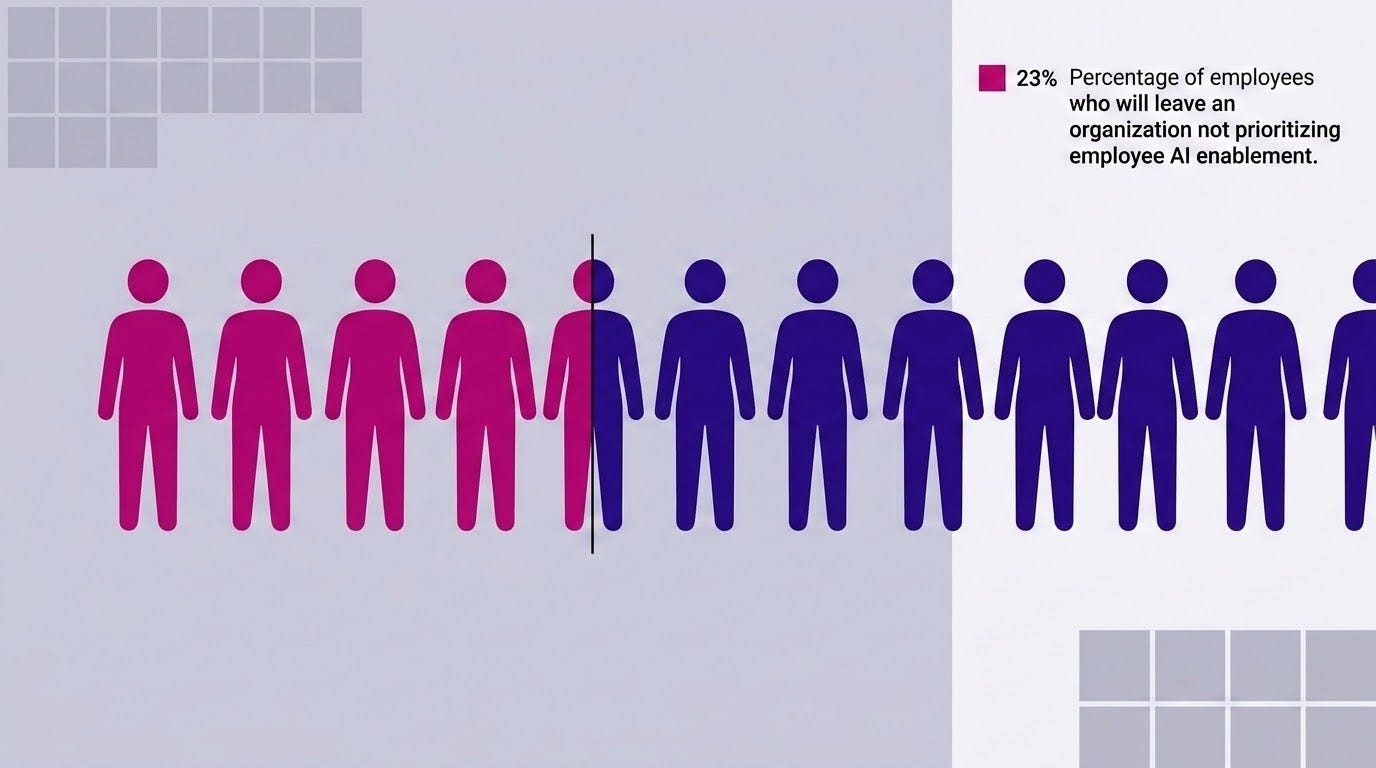
Two reports landed on the same desk in the same week. Microsoft documented that 65% of the workforce now fears falling behind on AI, 45% feels safer sticking with current goals than redesigning around AI, and only 13% are rewarded for the AI work they are already doing.¹ Randstad documented that 23% of tech professionals walked out of jobs in the past year because their employer trained the AI on them while training them on nothing.²
The instinct is to treat this as a workforce-management problem. More town halls. Better internal comms. A manager-training program for “AI fluency.” Microsoft itself named the phenomenon The Transformation Paradox; Randstad named it The Productivity Paradox. Both frames are accurate. Neither diagnoses the architecture problem.
Employees are not influencing their organization’s AI strategy. They are navigating their organization’s AI budget. The budget is the signal.
This Call names that architectural decision The People Bet. It is the share of AI capex you classify as workforce capability rather than as operational training expense. Betting on your people is what the company commits when it makes that reclassification — the same architectural decision named on opposite sides of the coin. What the CFO writes on the AI budget slide is what the workforce reads off it.
What 60% of AI Trailblazers do with their budget that 27% of Pragmatists don’t
BCG’s 2026 AI Radar surveyed top-performing companies — they classified Trailblazers based on documented AI ROI — and found a single allocation choice that separates the leaders from the middle of the pack. Trailblazers put 60% of their AI budget into workforce upskilling and retraining. Pragmatists put 27%. Followers put 24%.³
The 33-percentage-point gap between Trailblazer and Pragmatist allocation is the most predictive single capex choice in enterprise AI today. It explains, in one number, why two companies running similar AI infrastructure produce dramatically different returns six quarters later. Read that twice if you need to.
A 33-percentage-point gap separates Trailblazer and Pragmatist allocations on the People Bet. It explains, in one number, why similar AI infrastructure produces dramatically different returns.
The mechanism is not subtle. The People Bet is the line your workforce can read. When the People Bet on the AI capex slide is small relative to the infrastructure line, the workforce reads the signal correctly: the company is buying the technology, not the capability to run it. Retreat is the rational response. So is exit. Randstad’s 23%-have-quit figure is exactly what the BCG 33-point gap predicts at scale.
This is what Microsoft and Randstad are diagnosing — the same phenomenon, observed at the workforce-perception layer. These diagnoses are downstream effects of an upstream allocation choice the CFO already made.
If 27 cents of every AI dollar goes to your people, and 60 cents goes there at AI Trailblazers, whose AI return are you funding?
Where the underfunded People Bet shows up on the P&L
Three downstream costs the underfunded People Bet produces — each tractable, each citable, each on a CFO’s quarterly dashboard within two cycles.
1. Adoption looks healthy but sophistication does not. Microsoft’s 13%-rewarded figure and the parallel HBR / KPMG / UT Austin behavioral study — 1.4 million observed prompts across 2,500 employees over eight months — converge on the same number from opposite methodologies: roughly 5% of users demonstrate sophisticated AI engagement.⁴ The AI is deployed. The dashboard is green. The decisions are not getting better.
2. AI-fluent employees walk first. Randstad’s 23% exit figure is concentrated in the essential cohort the company most needs to retain. The same week’s Fortune coverage cites Google + Ipsos research finding AI-fluent workers are 4.5 times as likely to have received higher wages — confirming what the AI-fluent cohort already knows about its own market value.⁵ When the People Bet stays small, that essential cohort leaves first.
3. Most employees circumvent the official AI stack. When the IT-approved tools arrive without the workforce capability to use them effectively, employees build their own. Shadow AI is workforce arbitrage — and it strips the company of governance visibility, audit trail, and model-exposure control at the exact moment the AI workload most needs them.⁶
The training budget is operational. The People Bet is capital. Until they sit on the same slide, the rebalance never gets approved.
What the rebalance looks like in your next budget cycle
Three moves close the gap intentionally — before the AI-fluent cohort walks and forces the company to close it by default at higher cost.
1. Draw the People Bet. Reclassify the workforce-and-workflow AI investment from operational training budget to AI capex. The capital classification is the discipline.
2. Target the BCG benchmark. Set a Q3 2026 floor for the People Bet at the Pragmatist median (27%). Set a Q1 2027 target at the Trailblazer median (60%). The 33-percentage-point delta is the gap you close intentionally, on a documented timeline visible to the board — or close by default when the AI-fluent cohort resigns.
3. Route the People Bet spend to where it compounds. Generic AI literacy training does not work. Custom digital academies + role-specific reskilling + workflow audits — that combination is what Randstad’s data identifies as boosting workforce readiness by 56%.⁷ The spend matters; the routing matters more.
How Walmart placed the People Bet
In February of this year, Walmart’s Chief People Officer Donna Morris announced that all 1.6 million U.S. and Canadian frontline and corporate associates would receive free access to Google’s AI Professional Certification — an eight-hour foundational course on AI concepts and practical application.⁵ The announcement put Walmart alongside Verizon, Colgate-Palmolive, and Deloitte as named employers on the same Google credential — a four-company ecosystem the CFO of any retail or services company recognizes immediately.
What made the announcement architectural rather than performative was Morris’s framing. Speaking to Fortune, she called it “unfortunate” when companies use AI to replace workers instead of training them: “We as big employers should be actively engaged in trying to equip our respective employees — in our case associates — to be prepared for a world that is AI enabled and automated or digitized.” For Walmart, betting on their people surfaced as a stated capital commitment, not as a slogan.
Walmart’s new CEO, John Furner, reinforced the commitment in the same coverage cycle: “When we look out two years, three years, five years, where I think we’ll be is we’ll have roughly the same number of people we have today. We’re extending people’s career, and those jobs pay better. The attrition rates are really low.” The economic floor is documented in the same reporting: top-performing Walmart regional managers earn $420,000 to $620,000. Betting on Walmart’s people has a measurable career-ladder payoff the workforce can see.
The layoff was the announcement. The People Bet was the strategy. The workforce read both correctly.
What you put on the AI budget slide this quarter
You walk into the next CFO budget review. Three numbers belong on the slide: your current People Bet as a percentage of AI capex; the BCG Pragmatist floor (27%); the BCG Trailblazer target (60%). The conversation that follows is the architectural decision the rest of your AI strategy depends on.
You will not be able to rebalance your allocations in a single quarter. The Trailblazers did not either. What you do this quarter is draw the line and name the number — so the next four quarters have something to close against. The alternative is the path Microsoft and Randstad both already documented: 23% of your AI-fluent cohort starts looking, the dashboards stay green, and the sophistication gap widens until it shows up on the earnings call.
In The Replace-First Tax last week, I argued that layoffs preceding workflow redesign return on next year’s recruiting budget.⁹ Same architecture, different surface: a People Bet preceding the AI capex slide returns on next year’s AI ROI. The discipline is identical.
You budget the model with capex discipline. The People Bet teaches your workforce the rest.
The slide is yours to design, this quarter or next.
The AI Leadership Playbook
Strategic Questions (copy-paste ready for an email to your CFO and CHRO)
Q1. What is our current People Bet — the share of AI capex we classify as workforce capability — and where does it sit relative to the BCG Pragmatist median of 27%?
Q2. Which two workforce segments are most exposed to the Randstad exit pattern this fiscal year — and what is the cost of replacing the AI-fluent cohort we are most likely to lose?
Q3. What is our Q1 2027 target for the People Bet, and which workflow audits will we run this quarter to ground the number?
📅 Book a complementary 1:1 Strategy Session — 45 minutes to start that conversation about your AI transformation sequence.
Your Next Plays (copy-paste ready for an email to a direct report)
P1. Draw the People Bet. Reclassify the workforce-and-workflow AI investment from operational training budget to AI capex on the next budget slide. Same slide as infrastructure. Same level of CFO scrutiny. Owner: finance and HR leads, together — not separately.
P2. Set the two benchmarks. Anchor the People Bet to two BCG numbers: Pragmatist floor (27%) by Q3 2026, Trailblazer target (60%) by Q1 2027. The delta is the gap your company commits to closing — on a documented timeline visible to the board.
P3. Route the spend to where it compounds. Custom digital academies + role-specific reskilling + workflow audits. Not generic AI literacy training. Pick three functions under heaviest AI-investment pressure and run all three workflow audits in parallel before the next AI procurement cycle closes.
📬 Free preview ending soon. Subscribe to continue getting decision-grade AI intelligence that prepares you to move before your competitors do. First 100 subscribers receive bonus content.
How to measure the bet — next week
Next week’s Call lays out the framework that turns the People Bet into a board-reportable measure: The Judgment Premium. Decision-cycle, decision-reversal, board-visibility — three indicators that make AI ROI defensible to a board that already knows the headline number. The People Bet gets you the capacity. The Judgment Premium tells you whether it is compounding.
Sources
1. Microsoft (2026, May 13). 2026 Work Trend Index Annual Report. news.microsoft.com
2. Randstad Digital (2026, May 12). The AI Capability Gap: Why Technology Investment Fails Without Talent Infrastructure. Press release via PR Newswire.
3. BCG (2026, January). AI Radar 2026: As AI Investments Surge, CEOs Take the Lead on Decision Making and Upskilling Themselves. bcg.com
4. Harvard Business Review / KPMG / UT Austin McCombs (2026, March). What the Best AI Users Do Differently — and How to Level Up All of Your Employees. hbr.org
5. Fortune (2026, February 19). Walmart exec says it’s “unfortunate” that other companies are slashing workforces in the name of AI. fortune.com (Preston Fore).
6. Microsoft Edge Blog (2026, March 23). Protect your enterprise from shadow AI and more: Announcements at RSAC 2026. microsoft.com
7. CIO Dive (2026, May 13). AI investment outpaces employee skills. ciodive.com (Paige Gross).
8. Google. AI Professional Certification. grow.google
9. CognivaLab (2026, May 12). The Replace-First Tax. cognivalab.blog