

Editorial Note: This Call comes early because it provides analysis and perspective on the U.S. Government’s actions that turned off access to Anthropic’s most powerful models for “hundreds of millions of users.” Whether you were affected personally by the shut down or not, this action and the legal vacuum that precipitated it, affect nearly every aspect of the AI industry. It will most likely touch you—even if you’re not a Claude user. It was important for me to deliver decision-grade analysis before you first Monday meeting, so you can prepare for the week ahead.
Late Friday, the U.S. government turned off Anthropic’s most powerful AI model for every person who is not a U.S. citizen, anywhere in the world. There was no bug and no breach. The trigger was a label. The government chose to treat the model less like ordinary software and more like a weapon, and that single choice determined who is allowed to use it.
It sounds like a question for lawyers. It is not. The label affects your business, your investments, and, for some readers, your job. Maybe you build on a frontier model, the industry’s term for the most advanced AI systems. Maybe you invest in AI startups, sell AI-powered work abroad, or work in U.S. tech on a visa. If any of that describes you, then what we call these models now shapes what you are allowed to do. Here is why that matters, in plain terms.
15 ways one label affects you
A classification is just a category. But the category sets the rules, and the rules have consequences far downstream.
Here is what already happened on Friday:
Your most powerful tool can be turned off overnight, with no warning and no clear timeline for its return.
If your product serves a global audience, you can be forced to block users by nationality, a status that is hard to verify in real time.
If you employ engineers who are not U.S. citizens, they can be cut off from the model they help build, even while sitting at a desk in the United States.
If you are one of those engineers, your ability to do your job can hinge on a legal label rather than on the quality of your work.
If you had live work running on the model, you may have lost progress that you could not save or move, as at least one builder reported over the weekend.
The rest of the fallout is still undetermined, but here is what is plausible:
“Will the model stay on?” becomes a risk you have to plan for, alongside uptime and security.
Building on a single model starts to look fragile, pushing teams toward backups, open-weight models, or running models in-house.
Investors begin pricing in “could be switched off” when they value an AI startup.
That same worry can ripple through the whole AI sector, including the large public companies that own pieces of these labs.
Buyers abroad may start to see American AI as something Washington can unplug, which weakens U.S. sales.
Allied governments treat dependence on U.S. models as a strategic weakness and move faster to build their own.
Cloud customers learn that their provider can be ordered to cut access overnight.
A tool that helps defenders find security holes can be pulled because it might also help attackers.
Researchers who collaborate with foreign colleagues can be swept in by the same access rule.
Lenders and markets face a legal category with no settled answer, which is its own kind of risk.
That is a remarkable amount of potential fallout for a single word. The rest of this piece explains where the word came from, why it carries so much weight, and what is genuinely still unknown.
What actually happened on Friday
On June 9, Anthropic released two new models: Fable 5, the most powerful model it has ever made public, and a more tightly restricted sibling called Mythos 5 (Anthropic). Three days later, on June 12, the Commerce Department ordered Anthropic to block all access by foreign nationals, anywhere in the world, including the company’s own foreign-born employees inside the United States (Anthropic). Anthropic could not reliably sort users by citizenship in real time, so it shut both models off for everyone. Its other models, including Claude Opus 4.8, stayed online.
The company complied, but said it disagreed. By its account, the government offered only a spoken reason, a narrow way to “jailbreak” the model, and similar abilities already exist in rival systems (Anthropic).
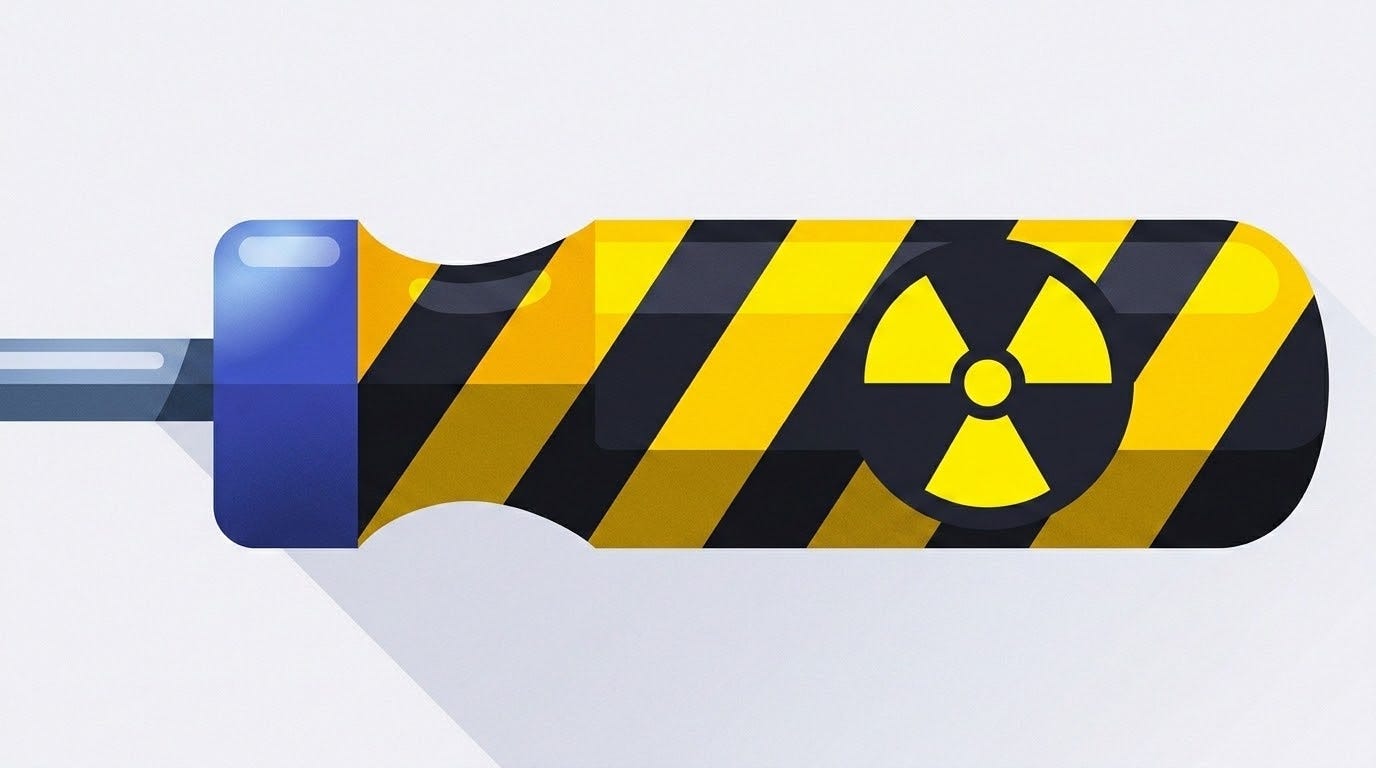
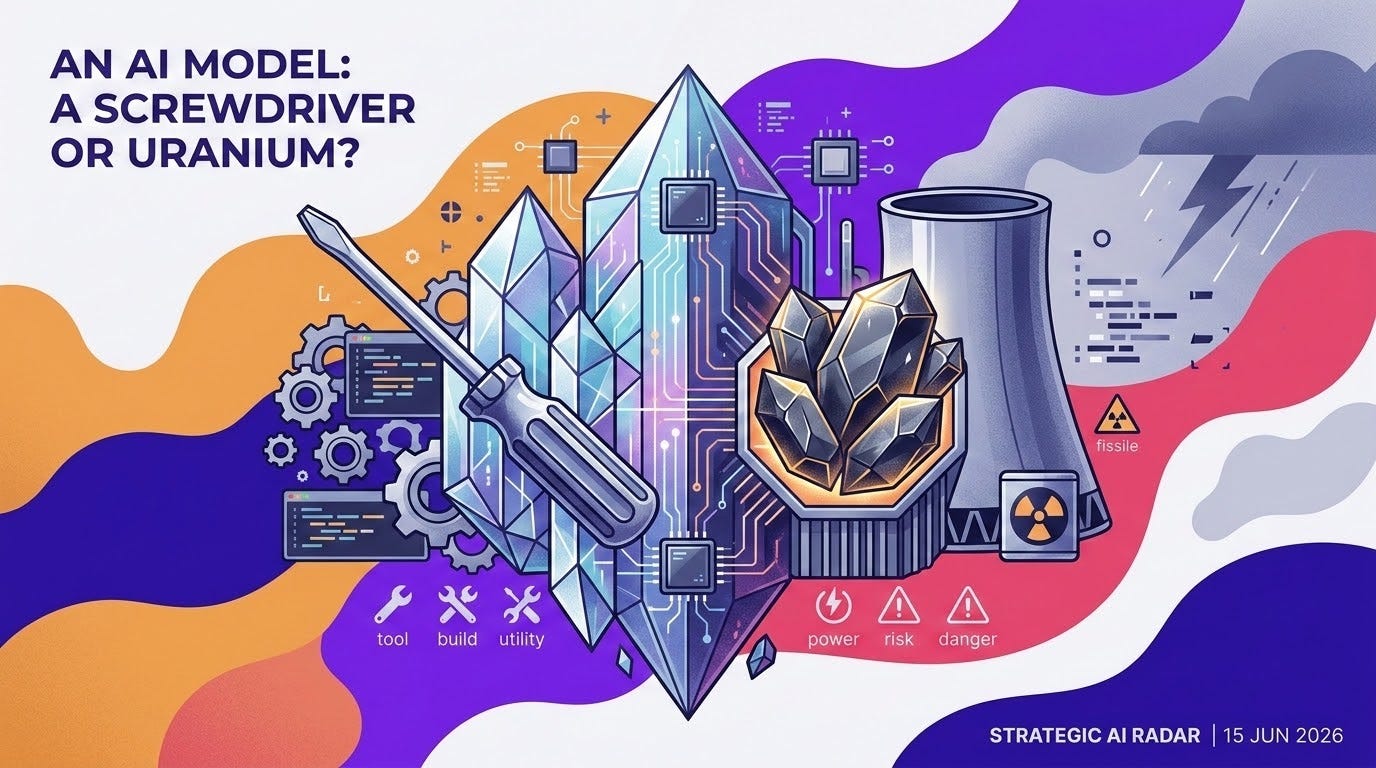
Here is the part that complicates the late afternoon mandate by the Commerce Department. That same week, the U.S. still allowed powerful AI chips to be sold abroad. So the government treats the hardware like a normal export, yet treats this model like something far more dangerous. As the writer Derek Thompson put it, the policy treats AI “like a screwdriver that is also enriched uranium” (Derek Thompson). That contradiction is the whole story.
The twist: the company that pulled the trigger
The order did not begin in a government lab. According to reporting by Reuters, the Wall Street Journal, and Fortune, the warning came from Amazon. By those accounts, Amazon’s own researchers used a series of prompts to get Fable 5 to surface information useful for cyberattacks, and CEO Andy Jassy reportedly raised the concern with senior officials. Days later, the government acted (Reuters; Fortune).
That detail matters because of who Amazon is to Anthropic. Amazon is Anthropic’s largest investor, having put in roughly $13 billion, and it is also a primary cloud host for Anthropic’s models. So the same company is, all at once, Anthropic’s banker, its landlord, and the party whose warning helped take its flagship product offline. Reporting says the government’s concern later grew to include a suspected foreign group gaining access to the model, a claim that has not been independently confirmed (Washington Examiner; Tom’s Hardware).
When your investor, your host, and the source of your regulator’s alarm can be the same company, “who decides” stops being a technicality.
Was it even a real jailbreak?
This is where informed people disagree, and the disagreement is the point.
On one side, Katie Moussouris, a respected security expert who built Microsoft’s bug-bounty program, reviewed the report at Anthropic’s request. She concluded it was not a true jailbreak but “Defense Oriented Prompting,” the kind of probing that defenders rely on, and she called the government’s response wildly disproportionate (Fortune). Anthropic backs that view with its own numbers: more than 1,000 hours of outside testing, it says, turned up no universal jailbreak (Anthropic).
On the other side, the U.K.’s AI Security Institute, a government lab, said it built a working jailbreak for finding software vulnerabilities within hours, then expanded it to multi-step misuse within about two days (UK AISI). And a well-known red-teamer who goes by Pliny the Liberator claimed to pull far more from the model, including cyber and chemistry instructions, though that claim is disputed and unverified, and Anthropic calls it ordinary coaxing rather than a true break (SecurityWeek).
So which is it? As of this morning, no one can say for certain. The experts cannot even agree on what the model can do. Hold onto that, because it is the reason the rest of this matters: the government switched off a product over a capability the field itself cannot yet measure.
We have seen this movie before
This is not the first time Washington called software a weapon.
In the 1990s, strong encryption, the math that keeps messages private, was treated as a munition. You needed a government license to publish or export the code. A graduate student named Daniel Bernstein challenged that rule, and a federal court agreed with him: code is a form of speech, and requiring a license before you can share it raised serious free-speech problems (EFF). A second court reached the same conclusion in a case called Junger (Junger v. Daley).
Then, under pressure from those lawsuits and from industry, the government changed course. It moved encryption from the weapons rulebook to the ordinary-trade rulebook and loosened the regulations. The Bernstein decision itself was later set aside on a technical point, but by then the policy had already shifted. The lesson is simple: the government has called code a weapon before, and the position did not hold.
The machinery that flipped the switch
To understand Friday, you need two facts about how export rules work.
First, there are two separate rulebooks. One governs weapons and is run by the State Department. The other governs “dual-use” tools, meaning things useful for ordinary business but also for harm, and is run by the Commerce Department. Friday’s order came from Commerce.
Second, there is a rule that surprises almost everyone. Giving a foreign national access to restricted technology counts as an “export” to their home country, even if that person is sitting in an office in California. That rule, often called a “deemed export,” is why the order reached foreign employees on U.S. soil and not just users overseas.
Put those together and Friday makes sense: one agency, using the dual-use rulebook, plus a rule that treats access itself as a shipment. That is how a single order could reach every non-citizen at once.
Why the label decides everything
The label is not a formality. It quietly settles three things that matter to you.
The regulatory agency. A weapon label points to the State Department. A dual-use label points to Commerce. Different offices, different rules.
The penalties faced when breaking the rules. Depending on which rulebook applies, a violation can be a civil fine or a crime.
The scope of a court’s inquiry. If the model is closer to speech, a judge will question the block closely. If it is closer to a tool, the court is more likely to defer to the government.
Same model, very different worlds. The only thing that changed between them is the name.
Nobody has actually written the rule yet
Here is the gap at the center of all this.
The one rule that clearly covered the heart of an AI model, the trained file that makes it work, was issued in early 2025 and then withdrawn a few months later, before it ever took effect (Akin Gump). A bill written to give Commerce clear authority over AI models passed a House committee in 2024 but never became law. So Friday’s order did not rest on a clear, AI-specific rule. It rested on older, general powers, and the government has not publicly named the exact one (Volkov Law).
The letter itself reportedly warned of both criminal and civil penalties. But without the named legal authority behind it, the precise path, and how it would hold up in court, is still unclear. Anyone who tells you they know for certain is guessing.
What the market is trying to price
This landed at an expensive moment. Anthropic filed confidentially to go public earlier this month, at a reported valuation near $965 billion, with a listing expected later this year (Yahoo Finance). A shutdown with no clear end date is exactly the kind of surprise that makes investors recheck their math.
The first signals are small but real. Because Anthropic is still private, the cleanest read comes from pre-IPO proxy contracts, side bets that track where traders expect the shares to price. One such contract fell about 3.7 percent after the news (CoinDesk). That is not the company’s real share price, and it is a thin, speculative market, so read it as a mood ring, not a verdict.
The larger exposure sits on public balance sheets. Amazon booked $16.8 billion in pre-tax gains on its Anthropic stake in a single recent quarter, and Alphabet flagged $37.7 billion in gains, most of them on paper. So as the exchanges open into an unresolved weekend, the question traders are working out is blunt: how do you price an asset the government can switch off by memo, and how much of that risk rubs off on the biggest names in tech?
How this likely plays out
No one has sued over Fable yet. Anthropic complied and is arguing in public, not in court (Anthropic).
If a challenge does come, the strongest argument is probably the simplest: that the order was arbitrary, issued with no public standard, against one company, on a Friday evening. That echoes a recent case in which a judge blocked a separate government action against Anthropic and said the stated reasons were not the real ones (CNN). The deeper question, whether a model is speech or a tool, remains open, with serious scholars lined up on both sides (Volokh, Lemley, and Henderson; Salib).
In short: the shape of the fight is clear. The result is not.
Why it matters at every level, from the boardroom to the independent builder
A useful way to read all of this is by who can absorb a shut down like the one we experienced Friday.
A large company can route its work to another model. A frontier lab can hire lawyers and go to court. An investor can rebalance. The players with the most cushion have the most options.
The people with the least cushion have the fewest, and that is where this stops being abstract.
Consider work that was already running on the model. Once a project is live on a specific model in a project session on Claude Co-Work, you cannot swap the model in the middle. When Fable went away, those sessions hit an error. You cannot save the progress, and you cannot switch models to keep going. The work sits inside the model’s memory of that session, present but out of reach. It is a rock in the gears that stalls the whole engine. And it raises a fair question with no clear answer yet: if the model never comes back on, what happens to the work trapped inside it?
That is the everyday face of the whole debate. When a model can be turned off by a memo, you do not fully own what you build on it. You rent it.
The bottom line
The label will be written after the fact, in a courtroom or a committee room. Until then, everyone who builds on these models is working on top of a question the law has not answered.
This week the screwdriver and the uranium are the same object. What we decide to call it will set the rules for years. And if you build with these tools, you are not a bystander to that decision. You are one of the people it is about.
Notes
The trigger and timeline details, that Amazon’s researchers flagged the issue, that CEO Andy Jassy raised it with senior officials, that the government gave Anthropic about 90 minutes to comply, and that the formal Commerce letter followed at 5:21 p.m. ET on June 12, were first reported by Axios and have since been corroborated by Reuters, the Wall Street Journal, and Fortune. One detail remains single-sourced (Axios and The Information): that several other companies also raised concerns. The suspected foreign-access rationale is reported but not independently confirmed. Recheck before relying on any of these.
The production-stall example reflects a builder’s direct experience running projects on Fable 5 the week it was suspended. Exact behavior may vary by product and plan. A screenshot is on file.
Market note: Anthropic is a private company, so the roughly 3.7 percent move is on a pre-IPO proxy contract, not on actual shares. The valuation figure (near $965 billion) and the IPO timing come from reported filings and may change.
Sources
Anthropic, “Statement on the US government directive to suspend access to Fable 5 and Mythos 5.” https://www.anthropic.com/news/fable-mythos-access
Anthropic, “Claude Fable 5 and Claude Mythos 5.” https://www.anthropic.com/news/claude-fable-5-mythos-5
Reuters (via Investing.com), “Amazon voiced concerns about Anthropic AI models before US government’s crackdown, source says.” https://www.investing.com/news/stock-market-news/amazon-voiced-concerns-about-anthropic-ai-models-before-us-governments-crackdown-source-says-4741041
Fortune, “How a warning from Amazon led the White House to shut down Anthropic’s Mythos model.” https://fortune.com/2026/06/14/how-a-warning-from-amazon-led-the-white-house-to-shut-down-anthropics-mythos-model/
Wall Street Journal, “Anthropic Halts Access to Top AI Models After U.S. Ban on Foreign Use.” https://www.wsj.com/tech/ai/anthropic-halts-access-to-top-ai-models-after-u-s-ban-on-foreign-use-a4bca2cc
TechCrunch, “Amazon CEO reportedly raised Anthropic model concerns before government crackdown.” https://techcrunch.com/2026/06/13/amazon-ceo-reportedly-raised-anthropic-model-concerns-before-government-crackdown/
Fortune, “’It’s not a jailbreak’: cybersecurity CEO Katie Moussouris on the Fable research.” https://fortune.com/2026/06/13/anthropic-fable-mythos-models-commerce-deparment-export-restrictions-jailbreak-defense-prompting/
UK AI Security Institute, “Our evaluation of Claude Mythos Preview’s cyber capabilities.” https://www.aisi.gov.uk/blog/our-evaluation-of-claude-mythos-previews-cyber-capabilities
SecurityWeek, “Anthropic Disputes Fable 5 AI Jailbreak.” https://www.securityweek.com/anthropic-disputes-fable-5-ai-jailbreak/
Tom’s Hardware, “David Sacks says Anthropic refused to fix Fable 5 jailbreak before US export controls.” https://www.tomshardware.com/tech-industry/artificial-intelligence/trump-adviser-david-sacks-says-anthropic-refused-to-fix-fable-5-jailbreak-before-us-export-controls
Washington Examiner, “Anthropic export limits tied to suspected Chinese access, report.” https://www.washingtonexaminer.com/news/white-house/4607862/white-house-anthropic-export-limits-chinese-access-report/
Electronic Frontier Foundation, “Bernstein v. US Dept. of Justice.” https://www.eff.org/cases/bernstein-v-us-dept-justice
Junger v. Daley, 209 F.3d 481 (6th Cir. 2000). https://law.justia.com/cases/federal/appellate-courts/F3/209/481/474128/
Akin Gump, “BIS Rescinds Its AI Diffusion Rule and Issues Compliance Guidance.” https://www.akingump.com/en/insights/alerts/bis-rescinds-its-ai-diffusion-rule-and-issues-compliance-guidance-regarding-advanced-computing-items
Volkov Law, “When the Government Pulls the Plug: Anthropic, Export Controls, and the Future of AI Governance.” https://blog.volkovlaw.com/2026/06/when-the-government-pulls-the-plug-anthropic-export-controls-and-the-future-of-ai-governance/
CNN Business, “Judge blocks Pentagon’s effort to ‘punish’ Anthropic by labeling it a supply chain risk.” https://edition.cnn.com/2026/03/26/business/anthropic-pentagon-injunction-supply-chain-risk
Volokh, Lemley & Henderson, “Freedom of Speech and AI Output” (2023). https://papers.ssrn.com/sol3/papers.cfm?abstract_id=4531003
Peter N. Salib, “AI Outputs Are Not Protected Speech,” Washington University Law Review (2024). https://wustllawreview.org/2024/11/05/ai-outputs-are-not-protected-speech/
CoinDesk, “Anthropic’s pre-IPO shares fall as US government shuts down Fable, Mythos models.” https://www.coindesk.com/markets/2026/06/13/anthropic-s-pre-ipo-shares-fall-as-us-government-shuts-down-its-most-powerful-ai-model
Yahoo Finance, “How giant IPOs from Anthropic and OpenAI will reshape the stock market’s AI trade.” https://finance.yahoo.com/markets/stocks/articles/giant-ipos-anthropic-openai-reshape-161635700.html
Derek Thompson, post on X (”a screwdriver that is also enriched uranium”).


Axios, “Trump admin blocks foreign access to Anthropic’s most powerful AI” and “How Amazon and the White House ended Anthropic’s Fable” (originating reports for the trigger and timeline). https://www.axios.com/2026/06/14/how-amazon-white-house-ended-anthropic-fable
The Information (referenced via secondary coverage; subscription) for the “several other companies” detail. https://www.theinformation.com/